Free Construction Contract Template
A Residential Construction Contract You Can Start From Today
A handshake does not protect your payment schedule. This free construction contract template covers parties, scope, price, payments, change orders, schedule, warranty, termination, and signatures for remodel and home improvement jobs, with clear flags for the state rules your attorney needs to check.

The Clauses Remodel Contracts Usually Need
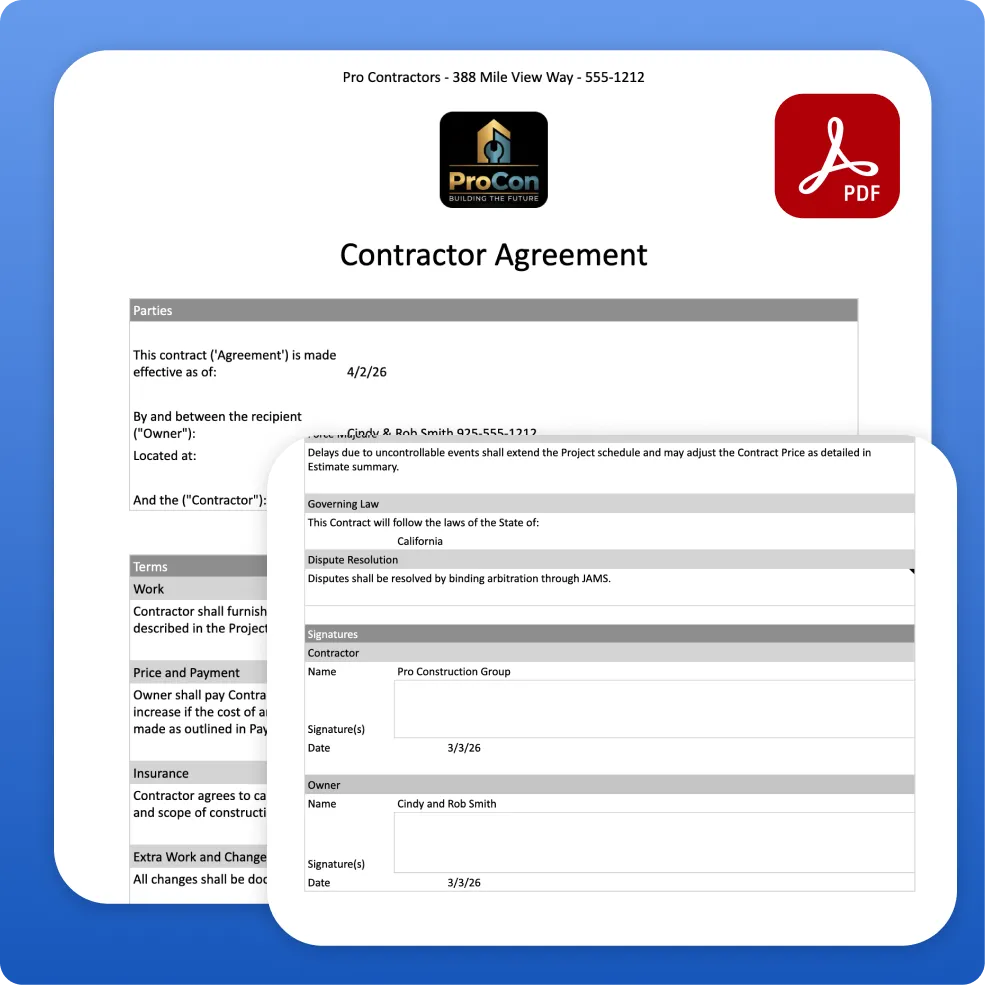
Sixteen numbered sections cover the parties and license number, project address, contract documents, scope, price and allowances, payment schedule, change orders, schedule and delays, permits, owner responsibilities, insurance, warranty, termination, dispute resolution, state notices, and entire agreement.
Exhibits for the detailed scope and required state notices are built in.
State Rules Vary: Get It Reviewed
Home improvement contract law varies by state. Many states require specific notices, deposit limits, and cancellation rights. This template is a starting point, not legal advice. Have a licensed attorney in your state review it before you use it.
Pair it with the change order template and lien waiver template.
How to Use This Construction Contract Template
Not legal advice. This template is general information to help you organize a contract. It is not legal advice and does not create an attorney-client relationship. Contract rules for home improvement work differ by state and sometimes by city. Have a licensed attorney in your state review your contract before you use it.
What's in the Construction Contract Template
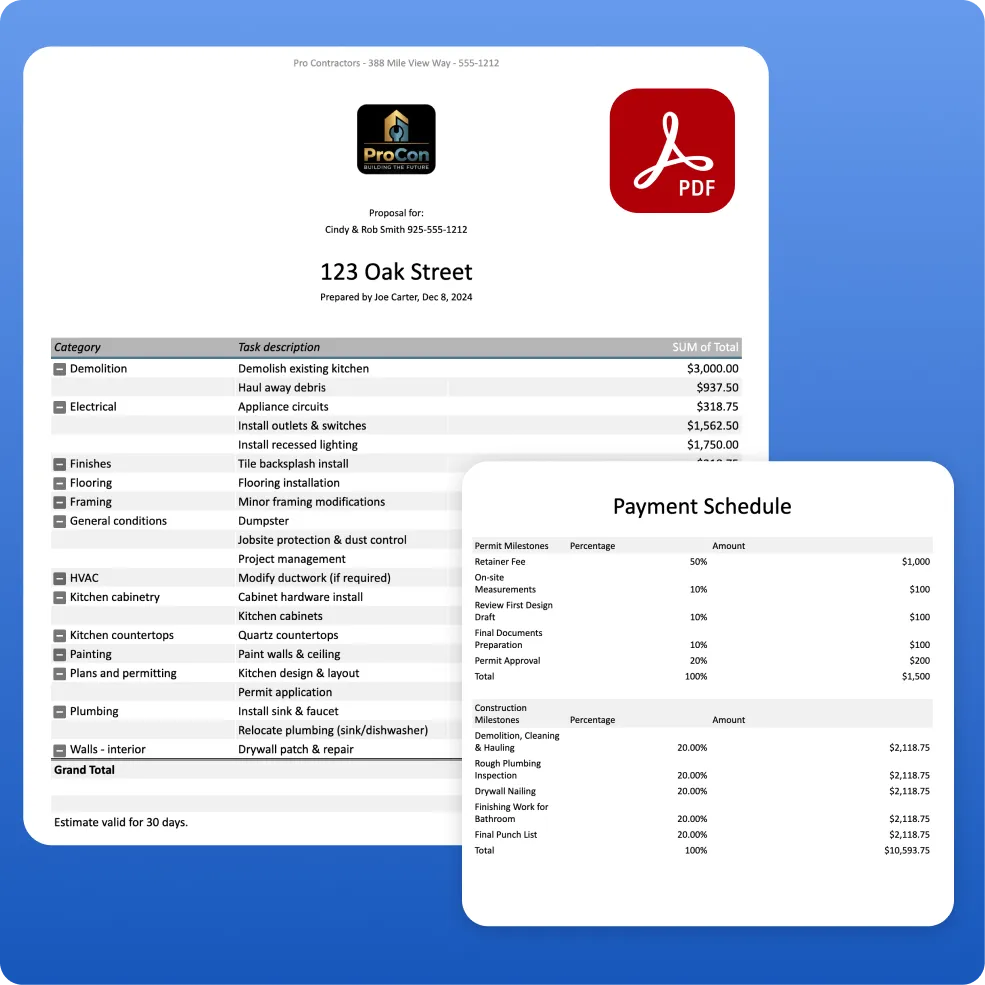
This free construction contract template is written for residential remodel and home improvement jobs between a contractor and a homeowner. It is an editable Word document (opens in Google Docs) with yellow fields for every blank, numbered sections, and two exhibits: one for the detailed scope of work and one for the notices your state requires.
| Section | What it covers |
|---|---|
| 1–3. Parties, location, contract documents | Who is contracting, license number, property address, and which documents (proposal, plans, change orders) are part of the deal |
| 4–5. Scope and price | The work, exclusions, contract price, and allowances |
| 6. Payment schedule | Down payment, progress payments tied to milestones, and final payment |
| 7. Change orders | Written, signed change orders before changed work, including concealed conditions |
| 8–10. Schedule, permits, owner duties | Start and completion dates, delays, who pulls permits, site access |
| 11–12. Insurance and warranty | Liability and workers' comp coverage, workmanship warranty period and exclusions |
| 13–14. Termination and disputes | Breach and cure period, payment on termination, mediation or arbitration |
| 15–16. Notices and entire agreement | State-required notices (Exhibit B) and how the contract can be changed |
State Rules to Check Before You Use It
These are examples of rules that often apply to home improvement contracts. They are not a complete list for any state:
- Deposit limits. California caps the down payment at $1,000 or 10% of the contract price, whichever is less (Business and Professions Code §7159.5).
- Required contract contents. California's home improvement contracts must include specific information and notices; the Contractors State License Board summarizes them for consumers.
- Cancellation rights. Under the FTC's Cooling-Off Rule, buyers generally have three business days to cancel certain sales made at their home, and the seller must give a cancellation notice. Some states add their own rules.
- Mechanics' lien notices. Many states require preliminary or lien notices to the owner. Put the required forms in Exhibit B.
How to Fill It In
- Fill in the parties, license number, and property address exactly as they appear on your license and the property records.
- Attach the detailed scope as Exhibit A. If you started from the construction proposal template, reuse its scope, allowances, and exclusions.
- Set the payment schedule by milestone, staying within your state's deposit limit.
- Choose your warranty period, cure period, and dispute method.
- Add the notices your state requires to Exhibit B.
- Have your attorney review the finished contract, then have both parties sign before work starts.
Related Templates
- Change order template to price and sign changes before the work is done
- Subcontractor agreement template for the trades on the job
- Lien waiver template to collect waivers with each payment
- Construction invoice template for progress billing
- Service contract template for repair and maintenance work
Sign Contracts and Change Orders in Eano Pro
Eano Pro sends proposals for e-signature and tracks change orders against the job, so the signed scope, price, and every approved change stay in one place.