Construction Proposal Management for Growing Contracting Teams
Skyrocketing material costs and tighter schedules mean every proposal counts more than it used to. For small-to-midsize contracting teams, a single missed detail or a proposal that goes out a day late can cost the job — and the referral that would have come with it.
Clients rarely wait around for a slow proposal, especially on smaller residential jobs where they're often comparing several contractors at once. The first complete, professional-looking bid to arrive has a real advantage — not because it's necessarily the best price, but because it's the one the client can actually evaluate first, while the others are still being assembled.
That cost compounds in a way that's easy to underestimate. A lost job isn't just a lost job — it's the introductions and repeat calls that job would have generated, none of which show up anywhere as a direct loss.
Why Speed and Accuracy Matter in Winning Construction Jobs
General contractors know the pattern: juggling multiple proposals at once, double-checking numbers against last week's material pricing, coordinating with subs who each have their own timeline. As a team grows, these tasks don't just happen more often — the coordination itself gets harder, because more people means more places for a detail to get lost. Even seasoned teams lose hours chasing down a missing scope item or reconstructing an estimate buried three replies deep in an email thread.
Getting proposals out fast and accurate isn't just about winning individual jobs. It's what protects margins on the jobs you do win, since a proposal built in a rush is where scope gaps and pricing mistakes actually originate.
Growth is what tends to expose this first. A founder handling every proposal personally can hold the whole process in their head — every scope detail, every subcontractor quote, every client's particular preferences. The moment a second or third estimator starts building proposals independently, that personal knowledge stops scaling, and whatever wasn't written down somewhere becomes a gap someone eventually falls into.
Speed and accuracy tend to get treated as a tradeoff — rush it and get it wrong, or slow down and get it right. In practice, the two aren't actually in tension once the underlying process is solid. A proposal built from current cost data and a repeatable template can go out fast precisely because it isn't being assembled from scratch each time, which means the choice between fast and accurate mostly disappears.
What Proposal Management Actually Protects
Proposal management isn't paperwork — it's the point where a bid either holds up under real costs or quietly erodes margin. Handled well, it reduces the change orders that come from an ambiguous scope, and it makes a team's estimates look consistent and reliable to a client comparing multiple bids.
Manual methods — spreadsheets, Word docs, a folder of PDFs — make it easy to miss a scope item or carry forward a math error from the last template. Centralizing proposal details in one place is less about looking modern and more about removing the specific point where those mistakes happen.
There's a competitive dimension here too, separate from internal accuracy. A client comparing three bids is, whether consciously or not, also comparing how organized each contractor appears to be. A proposal with consistent formatting, clear scope language, and pricing that holds together reads as more trustworthy than one that looks assembled the night before — even when the underlying work would have been identical.
Change orders trace back to proposal quality more often than either side of the conversation usually realizes. A scope that reads clearly to the person who wrote it can still leave real ambiguity for the client reading it cold — and that ambiguity, once construction starts, becomes a change order rather than a clarifying question, because by then it's too late to just ask. Tighter proposal management is, in a real sense, change-order prevention that happens weeks before the job even starts.
What Changes When the Process Goes Digital
The practical difference shows up in two places: revisions and client feedback get tracked against a single version instead of scattered across email threads, and pricing gets pulled directly from job-costing data instead of retyped from a spreadsheet that may already be a version behind. That second point matters more than it sounds — retyping a number is exactly where a decimal point gets dropped.
Less time spent reconciling versions means more time on the jobsite, or on the next proposal that's actually worth chasing.
The version-tracking piece specifically solves a problem that gets worse, not better, as a team grows. Two proposals sent to the same client eighteen months apart should reflect the same standards and the same level of detail — but without a shared system, that consistency depends entirely on whoever happens to be building each one, and on how closely they remember what the last proposal looked like.
Digital tracking also changes what a "final" proposal actually means. In an email thread, the final version is whichever attachment someone happened to open last — there's no single record either party can point to with confidence. A shared, versioned system makes the current state of a proposal unambiguous for everyone looking at it, client included, which removes a surprising amount of the back-and-forth that otherwise happens simply because two people are looking at two different files.
How Eano Pro Handles Proposals for Growing Teams

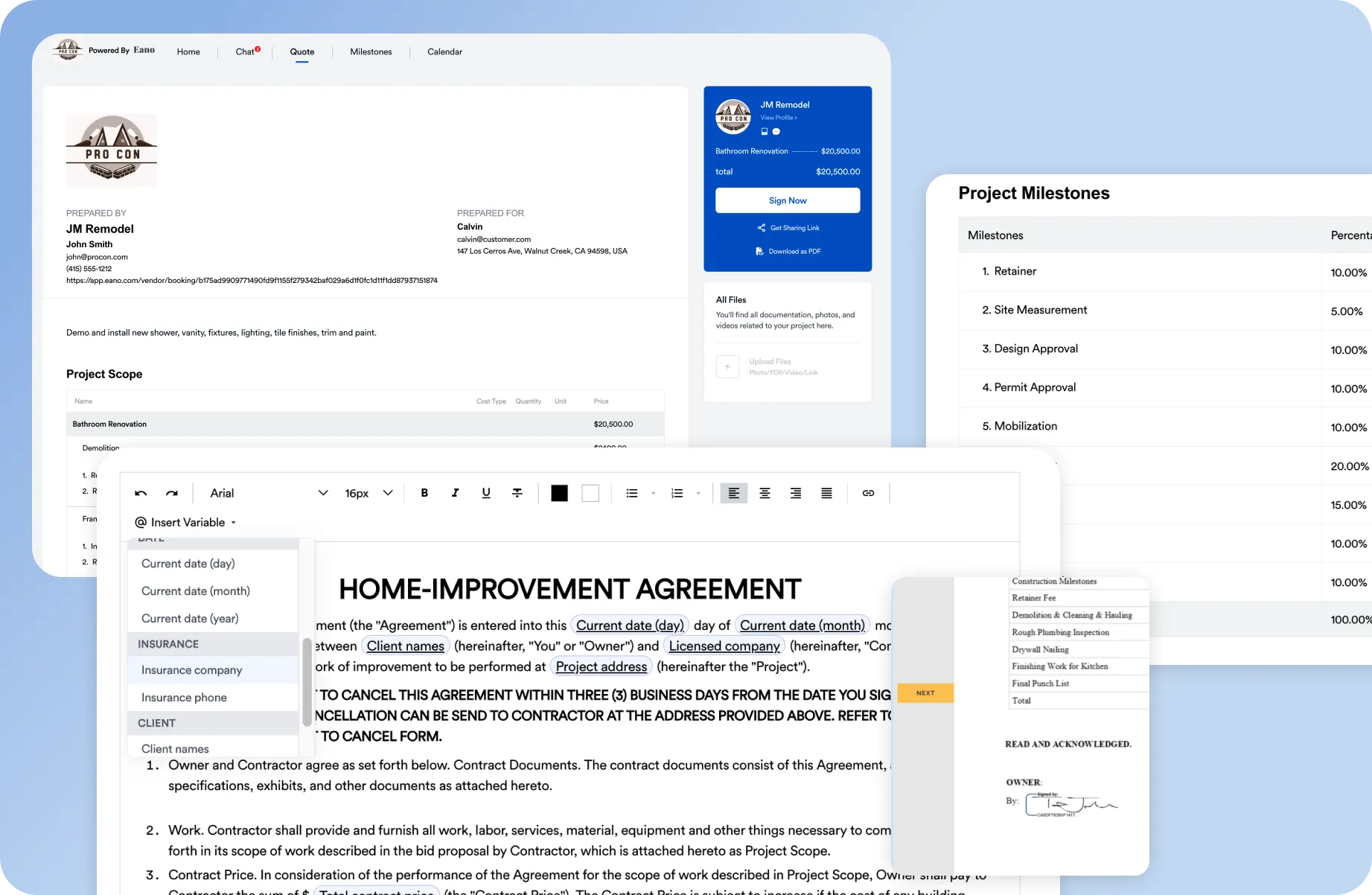
Eano Pro centralizes the proposal workflow shown above — from initial estimate to client sign-off — in one system built specifically for general contractors and growing teams, rather than a generic document tool repurposed for construction.
The platform tracks cost across materials, labor, and subs in real time and handles digital signatures inline, so approvals don't stall waiting on a printed page or a separate e-sign tool. You can see the full workflow at Eano Pro's proposal management page.
Because every proposal draws from the same underlying cost data, a growing team doesn't need to worry about one estimator pricing a job differently than another simply because they're each working from a different version of the numbers. The pricing behind a proposal is consistent by default, not by coincidence of who happened to build it.
The e-signature piece matters more for a growing team than it might for a solo operator, mostly because of who's actually waiting on the approval. When a proposal has to be printed, signed, scanned, and emailed back, the delay isn't really about the client's decision — it's about the mechanics of getting a signature onto a document, which is friction that has nothing to do with whether the client actually wants to move forward. Removing that step tends to shorten the gap between "yes" and a signed contract by more than people expect going in.
Making the Switch: What to Expect
Switching doesn't require rebuilding your process from scratch. Most teams start by importing existing proposal templates and cost libraries, then let the tool's structure guide the rest — there's a real difference between a platform that demands you relearn how to bid and one that digitizes what you already do.
The improvements that show up first are usually the least dramatic ones: proposals that look consistent from job to job, and fewer of the small pricing mistakes that quietly eat into a margin nobody notices shrinking until the job's done.
The transition period is usually shorter than teams expect, mostly because the actual estimating work doesn't change — the tool handles the assembly, formatting, and version tracking around it. A team that already knows how to price a job well doesn't have to relearn that skill; they just stop losing time to the parts of the process that were never really about estimating in the first place.
A reasonable way to plan the switch is to run it alongside the existing process for the first handful of proposals rather than cutting over all at once. That overlap period is where a team gets comfortable with the new workflow while there's still a familiar fallback available, and in practice most teams find they stop reaching for the fallback well before they expected to.
What Actually Matters for Growing Teams
The feature that separates real proposal management from a digitized form isn't the form itself — it's what's connected to it: a cost code library that keeps pricing consistent across estimators, change-order tracking tied directly to the original proposal instead of a separate document, and a shared view subs and office staff can both work from without a phone call to sync up.
Centralizing those pieces is what actually reduces the handoffs and miscommunication that cost jobs — not the interface, but what's underneath it.
Change-order tracking tied to the original proposal deserves particular attention, since it's often where growing teams feel the most pain. Without that link, a change order is effectively a new, disconnected document — and a client questioning the total has to take the team's word for how it relates to what was originally signed. With the link intact, the connection between the original scope and the change is visible to everyone, which tends to shorten the conversation considerably.
A shared view for subs and office staff closes a different gap — the one between what was proposed and what actually gets built. A sub working from an outdated scope sheet, printed once at the start of the job and never updated, is a common and avoidable source of rework. Keeping that sheet live and shared means a scope change made in the office is the same scope a sub sees on-site, without a phone call needed to confirm it.
Why Simplicity Wins for Small and Midsize Contractors
A contracting team growing past a handful of people doesn't have time to configure software with features nobody uses. Eano Pro is built around a narrower goal: making it fast for a team to create, track, and send proposals that win work, without the overhead of a platform built for a much larger back office.
Get Started with Eano Pro
The improvement most teams notice first isn't a bigger win rate — it's fewer hours spent per proposal and fewer late-night edits before something goes out the door. Ready to see how Eano Pro can streamline proposal management for your team? Book a demo today and see how your next proposal can go out faster and with fewer errors. Book a demo.