

Reducing Change Order Risks with AI Construction Estimating and Real-Time Analytics
A change order isn't usually caused by a client changing their mind — more often, it traces back to a scope that was vague or an estimate that was rushed in the first place. Fixing the change order after the fact costs far more than getting the estimate right before the bid ever went out.
That difference in cost is the whole argument for spending more time up front. A change order isn't just a line item — it's a renegotiation, a pause in the schedule, and often a harder conversation with a client who thought the number was settled.
How Small Errors Become Big Problems
Construction runs on tight margins, and one overlooked spec or missed line item can throw off an entire job's profitability. Change orders are frequently triggered by scope that was left ambiguous or an estimate that skipped a step to save time. When the numbers aren't dialed in at the start, the cost shows up later — in time, money, and a harder conversation with the client than the one that would have happened up front.
Estimating built on guesswork and a rushed spreadsheet tends to produce incomplete bids and missed material costs, which is exactly the pattern that leads to a change order down the line.
The error itself is rarely dramatic. A quantity takeoff that's off by a small percentage, a spec that got interpreted one way by the estimator and another way by the client, a supplier price that moved between the bid and the order — any one of these is a normal, human-scale mistake. What makes it expensive is how long it sits undetected. Caught during estimating, it's a five-minute correction. Caught mid-framing, it's a change order, a schedule slip, and a client who now wonders what else might be off.
Part of what makes these errors hard to catch is that a spreadsheet rarely shows its own gaps. A missing line item just isn't there — there's no flag, no warning, nothing on the page that stands out. The mistake only becomes visible once the crew is on-site and the missing material or labor line becomes obvious in a way it never was on paper. By then, the fix costs a lot more than the few minutes it would have taken to catch during the original review.
What a Change Order Actually Costs
The dollar amount on a change order is rarely the whole story. There's the direct cost of the additional work, but there's also the schedule impact — a change order almost always means waiting on a decision, a re-order, or a re-sequencing of the crew, and that delay has a way of pushing into whatever was scheduled next. A subcontractor booked for the following week may need to be pushed back, which can mean losing their slot entirely if their calendar fills up in the meantime.
There's an administrative cost too, one that's easy to overlook because it doesn't show up as a line item. Someone has to document the change, price it, get it approved, and update the schedule — all time that isn't going toward the job itself. On a project with several change orders, that overhead adds up to real hours that were never part of the original bid.
The least tangible cost is the one that matters most over time: trust. A client who signed off on a number and then watches it move upward, even for legitimate reasons, starts reading every subsequent number more skeptically. That skepticism shows up later — in a slower approval process, in more questions about routine costs, in a client who's less likely to refer the contractor to someone else. Reducing change orders isn't just about protecting a single project's margin; it's about protecting the reputation that wins the next one.
Where AI and Real-Time Data Actually Help
The goal isn't fewer surprises for its own sake — it's tighter control over what an estimate is actually based on. Eano Pro's AI-assisted estimating pulls from current market prices, historical job data, and project specs to generate a comprehensive estimate faster than building one from scratch, though a number the system suggests is a starting point that still benefits from a second look on anything unusual about the job.
What that speed buys is time to actually review the estimate before it goes out, instead of rushing it out the door because there wasn't time to build it properly in the first place — which is often where the missed line item actually originates.
That extra review time matters more than it sounds. An estimator working against a deadline tends to trust the first number that looks reasonable; an estimator with time to spare tends to check it against what similar jobs actually cost. AI-assisted estimating doesn't replace that second look — it's what makes room for it, by cutting the hours spent building the first draft of the bid.
Getting Granular with Real-Time Project Data
A static spreadsheet is a snapshot from the day it was built. Real-time access to cost fluctuations, quantities, and crew productivity means reacting to actual conditions on a job rather than a forecast made weeks earlier. Combined with AI-assisted estimating, that visibility is what keeps a budget on track when material prices move or labor gets tight — adjustments happen while there's still time to make them, not after the fact.
The practical version of this is a project manager noticing a cost trending up two weeks before it becomes a problem, rather than discovering it at the monthly reconciliation when the only options left are absorbing the overrun or asking the client for more money.
Consider the difference between two versions of the same delay. In one, a material price spikes mid-job and nobody notices until the invoice arrives, at which point the only options are eating the difference or going back to the client for a change order that reads as a surprise. In the other, the same spike shows up on a live cost dashboard within a day or two, giving the project manager time to either substitute a material, adjust the schedule to buy the price time to settle, or flag it to the client early enough that the conversation is a heads-up instead of a confrontation. The underlying event is identical; what changes is how much runway there is to respond to it.
One Platform, Fewer Gaps
Eano Pro is a construction management platform built for clarity at each step of a job, not just at the estimate. In practice, that means updates reach the team and subs instantly instead of at end-of-day, real-time analytics can surface a scope gap before a contract is signed rather than after, and changes and approvals get tracked so nothing depends on someone's memory of a phone call. Reducing change-order exposure starts with those gaps closing before the job begins — see how it works on Eano Pro's AI estimating page.
A gap between systems is where most change orders actually originate, even when nobody involved made an obvious mistake. The estimate lived in one file, the schedule in another, and the client's approved changes in an email thread — and by the time all three get compared, the story they tell doesn't quite agree.
How Eano Pro Reduces Change Order Risk Specifically
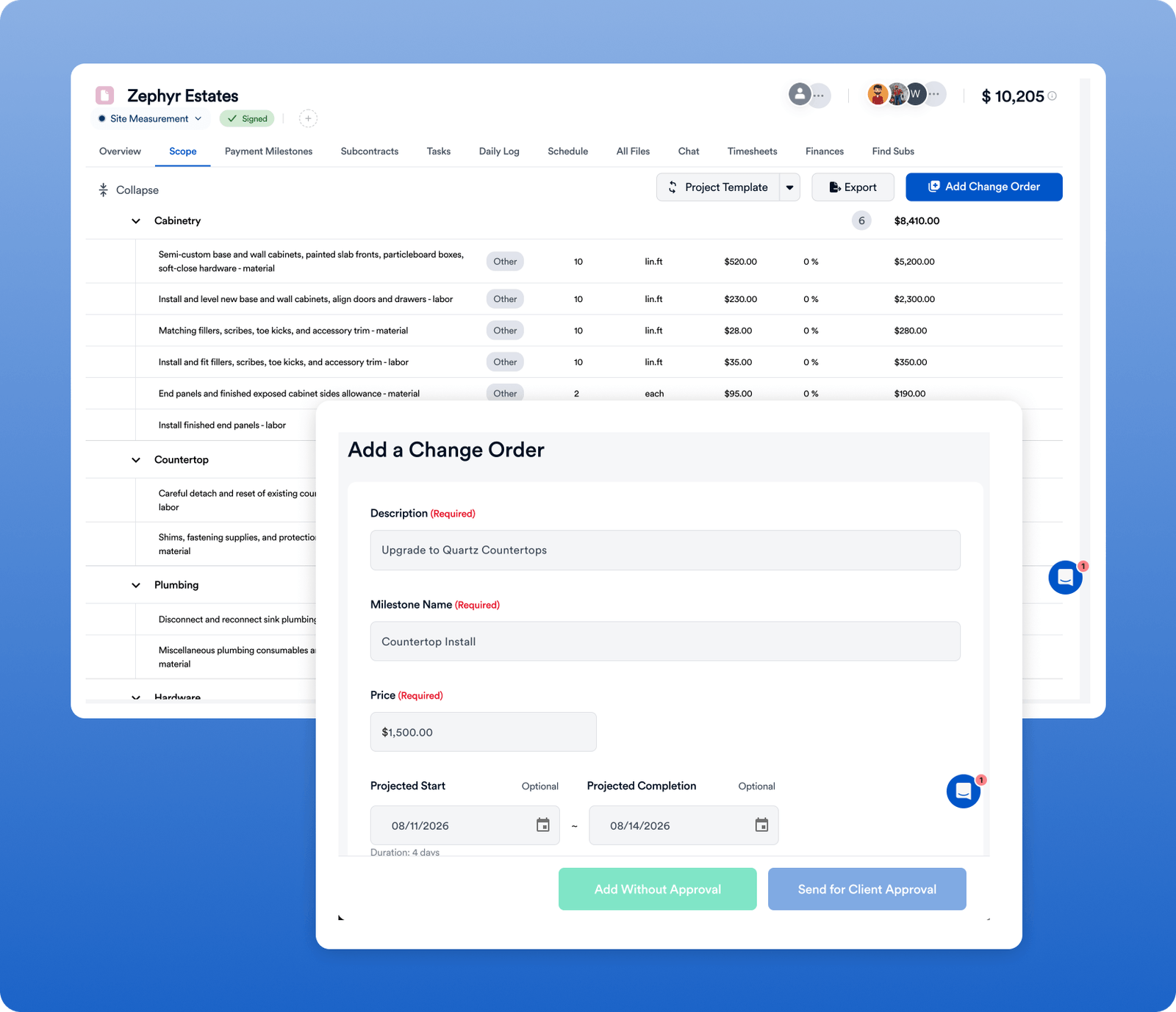
Beyond the general benefit of having one system instead of several, Eano Pro addresses change-order risk in a few specific ways. The estimate a client signs becomes the same document the project management side works from — not a static PDF that gets set aside once the job starts, but a living record the schedule and budget both reference. When a scope question comes up mid-job, the answer is in the same platform as the original bid, not buried in an inbox.
Change requests get logged and priced against the original estimate directly, so a client sees exactly what changed and why the number moved, instead of a number that just shows up different with no visible trail back to the decision that caused it. That visibility is often what determines whether a change order becomes a disagreement or a routine part of the job — a client who can see the reasoning rarely pushes back on it the way a client blindsided by a number does.
Because field updates flow into the same system in near real time, a scope gap — a wall that turns out to need more framing than estimated, a permit requirement that wasn't in the original scope — tends to surface while it's still a conversation rather than after it's already been built the wrong way.
The role-based access built into the platform matters here too. A project manager, an estimator, and a client don't need to see the same view of a job, and Eano Pro doesn't force them to — each sees what's relevant to their part of the decision, which keeps the record clean without burying anyone in details that aren't theirs to manage. Check out Eano Pro construction change order software.
Practical Steps to Reduce Change Order Exposure
Start with a genuinely detailed scope and a complete estimate — AI tools can help spot missing items and inconsistent quantities, but the scope itself still has to be walked and understood, not assumed. From there, monitor the job in real time; a platform that flags cost overruns and potential delays as they happen gives you room to act instead of reacting after the fact. Last, keep stakeholders genuinely in the loop — fast, transparent updates are what prevent a misunderstanding from becoming a change order in the first place.
None of these steps is complicated on its own. What makes them effective together is that they close the same gap from three directions — a better starting estimate, live visibility while the job runs, and a client who's seeing the same information the office is.
Modernizing How Bids Get Built
Estimating built entirely on experience and instinct has real value, but it also has a ceiling — nobody remembers every historical price or catches every inconsistency by hand, every time. AI-assisted estimating reviews bids against historical data, matches specs to supplier costs, and flags inconsistencies a busy estimator might miss on the tenth bid of the week. Paired with real-time analytics, that means working from current information instead of what was true when the estimate was first drafted — and comparing outcomes against real benchmarks rather than a gut feel.
That shift doesn't diminish an experienced estimator's judgment — it gives that judgment better inputs to work from. The estimator still decides what a job actually needs; the tool just makes sure that decision is informed by current numbers instead of whatever was true the last time a similar job was priced.
It also changes the conversation when a bid loses to a competitor. Without good data, a lost bid is hard to learn from — was the price too high, was the scope misread, or did the client just go with someone they already knew? With historical estimate data and outcomes tracked in one place, a pattern across several lost bids becomes visible in a way it never was when each estimate lived in its own spreadsheet, disconnected from what actually happened to the job afterward.
Where This Sets Contractors Up for Success
The practical goal is winning profitable jobs while actually defending the margin on them — spending less time fixing mistakes after the fact and more time on the work itself. Ready to reduce surprise change orders? Book a live demo of Eano Pro and see how estimating and real-time analytics work together to protect your bottom line. Schedule your demo here.