
How Construction Management Software Helps You Scale
Most contractors don’t hit a growth ceiling because they run out of demand.
They hit it because things start to feel harder the more work they take on.
More jobs should mean more revenue. But in reality, it often means more chaos—more calls, more scheduling conflicts, more things slipping through the cracks. What used to feel manageable starts to feel reactive.
You’re still getting work done. You’re still closing jobs. But it takes more effort to keep everything moving.
That’s usually the point where growth stalls—not because the business can’t grow, but because the systems behind it haven’t caught up.
This guide explains why growth breaks informal systems, what to systematize at each stage, from a couple of jobs to ten or more, and which tools take admin work off your plate as you scale.
Why Growth Breaks What Used to Work
Early on, most construction businesses run on a mix of memory, hustle, and a handful of tools.
You know what’s happening on every job because you’re involved in all of them. Communication is mostly direct. Scheduling lives in your head or in a simple calendar. Estimating might be a spreadsheet you’ve refined over time.
And for a while, that works.
But once you start running multiple jobs at the same time—especially with different crews and subcontractors—that approach starts to break down.
You can’t be everywhere at once. You can’t remember every detail. And you can’t personally catch every issue before it turns into a problem.
What used to be a strength—being hands-on—becomes a bottleneck.
The Real Problem: It’s Not Volume, It’s Complexity
A lot of contractors assume scaling is just about handling more volume.
In reality, it’s about managing more complexity.
Every additional job introduces:
- More moving parts
- More people involved
- More communication paths
- More opportunities for things to go wrong
It’s not linear. Going from 2 jobs to 5 doesn’t feel like 2.5x more work—it feels like a completely different level of coordination.
And without systems in place, that complexity turns into stress.
Where Things Start to Slip
You can usually tell when a business is hitting that scaling wall.
It shows up in small ways at first:
- Jobs taking longer than expected
- More frequent scheduling conflicts
- Subcontractors needing more follow-up
- Clients asking more “what’s going on?” questions
- Estimates getting rushed just to keep up
None of these feel like major issues individually. But together, they create friction across the business.
And over time, that friction limits how much you can grow.
Why Hiring More People Doesn’t Fix It
A common reaction to growth pressure is to hire more people.
More project managers. More coordinators. More admin support.
And while that can help in the short term, it doesn’t solve the underlying issue.
If the system is unclear or inconsistent, adding more people often just adds more communication overhead. Now there are more handoffs, more chances for misalignment, and more time spent coordinating.
You end up managing the team instead of managing the business.
Scaling isn’t just about adding capacity—it’s about improving how work flows.
What Scaling Actually Requires
At a certain point, growth stops being about effort and starts being about structure.
To scale effectively, you need:
- Consistency – jobs are run in a similar way every time
- Visibility – you can see what’s happening without asking around
- Repeatability – processes don’t rely on memory or specific individuals
Without those, every new job adds pressure.
With them, growth becomes more predictable.
From “Running Jobs” to “Running a System”
One of the biggest shifts contractors go through is moving from personally managing everything to managing a system that manages the work.
Early on, you’re involved in:
- Every estimate
- Every schedule
- Every key decision
As you grow, that stops being sustainable.
Instead, the goal becomes:
- Setting up processes that guide how work gets done
- Giving your team clarity on what to do
- Having visibility without needing to be involved in every detail
That’s what allows you to step back without losing control.
How Construction Management Software Supports This Shift
All-in-one construction management software helps bridge the gap between how you operate today and how you need to operate as you grow.
It doesn’t replace your experience—it organizes it.
Instead of relying on scattered tools and memory, it gives you a system where:
- Projects are structured consistently
- Communication is centralized
- Schedules and tasks are visible across jobs
That creates alignment without constant oversight.
Standardizing How Jobs Are Run
One of the biggest advantages is standardization.
When every job follows a similar structure—whether it’s a remodel, a build, or a service project—it becomes easier to:
- Train new team members
- Delegate responsibilities
- Spot issues early
You’re not reinventing the process each time. You’re refining it.
That consistency is also what allows contractors to improve estimating accuracy across jobs, instead of relying on guesswork each time.
Improving Team Alignment Without Micromanaging
As your team grows, alignment becomes harder.
People interpret things differently. Updates get missed. Responsibilities blur.
With a centralized system, expectations become clearer.
Tasks are assigned. Timelines are visible. Updates are shared in context.
Instead of constantly checking in, you can trust that people have what they need to do their work.
And a big part of that comes down to reducing miscommunication across your projects, especially as more people get involved.
Managing Multiple Jobs Without Losing Track
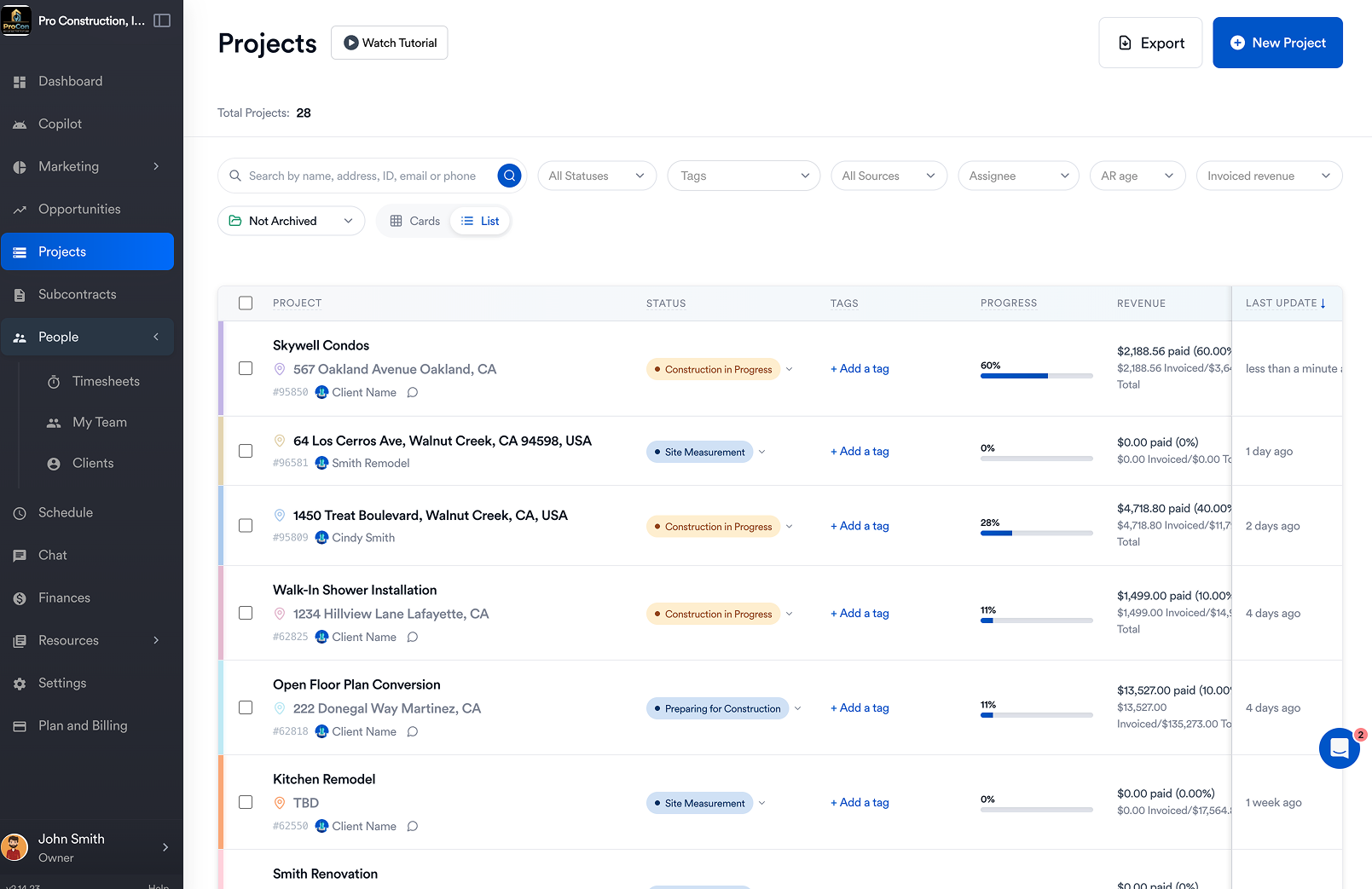
This is where scaling usually feels the hardest—juggling multiple projects at once.
Without a system, you’re relying on:
- Memory
- Messages
- Constant check-ins
With a system, you can see:
- What stage each job is in
- What’s coming up next
- Where things might be slipping
That visibility alone reduces a lot of stress.
What to Systematize at Each Stage of Growth
The stages below are rough guides, not hard cutoffs. Use the symptoms column to figure out where you actually are.
| Stage | What starts to break | What to systematize | Software that helps |
|---|---|---|---|
| 1–2 jobs at a time | Owner remembers everything; estimates are rebuilt from old files | Estimate templates, a single price list | Estimating and proposal tools |
| 3–5 jobs at a time | Scheduling conflicts; clients calling for updates; sub follow-up by text | Shared schedule, daily logs, client updates | Scheduling, daily logs, client dashboard |
| 6–10 jobs at a time | PMs work differently from each other; costs found late | Standard job setup, budget vs. actual tracking, change order process | Project management, job costing, change orders |
| 10+ jobs or multiple crews | Owner can't see the business without asking around | Pipeline, crew time, and cash flow reporting in one place | CRM, timesheets, accounting integration |
Which Tools Reduce Admin Work While You Scale?
Start with an admin audit. For one week, have the office and PMs note every task they do more than three times. Then match each one to a tool:
| Repeated admin task | What replaces it |
|---|---|
| Rebuilding estimates from old files | Estimate templates and a saved cost library |
| Retyping estimates into proposals and contracts | Proposals and e-sign generated from the estimate |
| Calling crews for status | Daily logs with photos from the field |
| Answering "what's going on?" calls from clients | A client dashboard with progress and approvals |
| Collecting paper time cards | Mobile clock-in and time card approvals |
| Re-entering invoices into accounting | An accounting integration such as QuickBooks |
Example (illustrative)
A remodeler running six jobs finds the office manager spends a large part of each week answering client update calls and chasing time cards. Moving client updates to a dashboard and time cards to a mobile app doesn't cut headcount. It frees that person to handle billing and scheduling, which were falling behind. Your numbers will differ. The point is to measure the admin load before deciding what to automate.
For how this plays out between the office and job site, see how construction management software supports field and office teams. If you're new to the category, start with what construction management software is. For the cost-control side of growth, our guide to construction job costing shows how to compare estimated and actual costs. And for the case for centralizing early, read scaling without chaos with centralized systems.
How Eano Pro Helps You Scale Without the Chaos
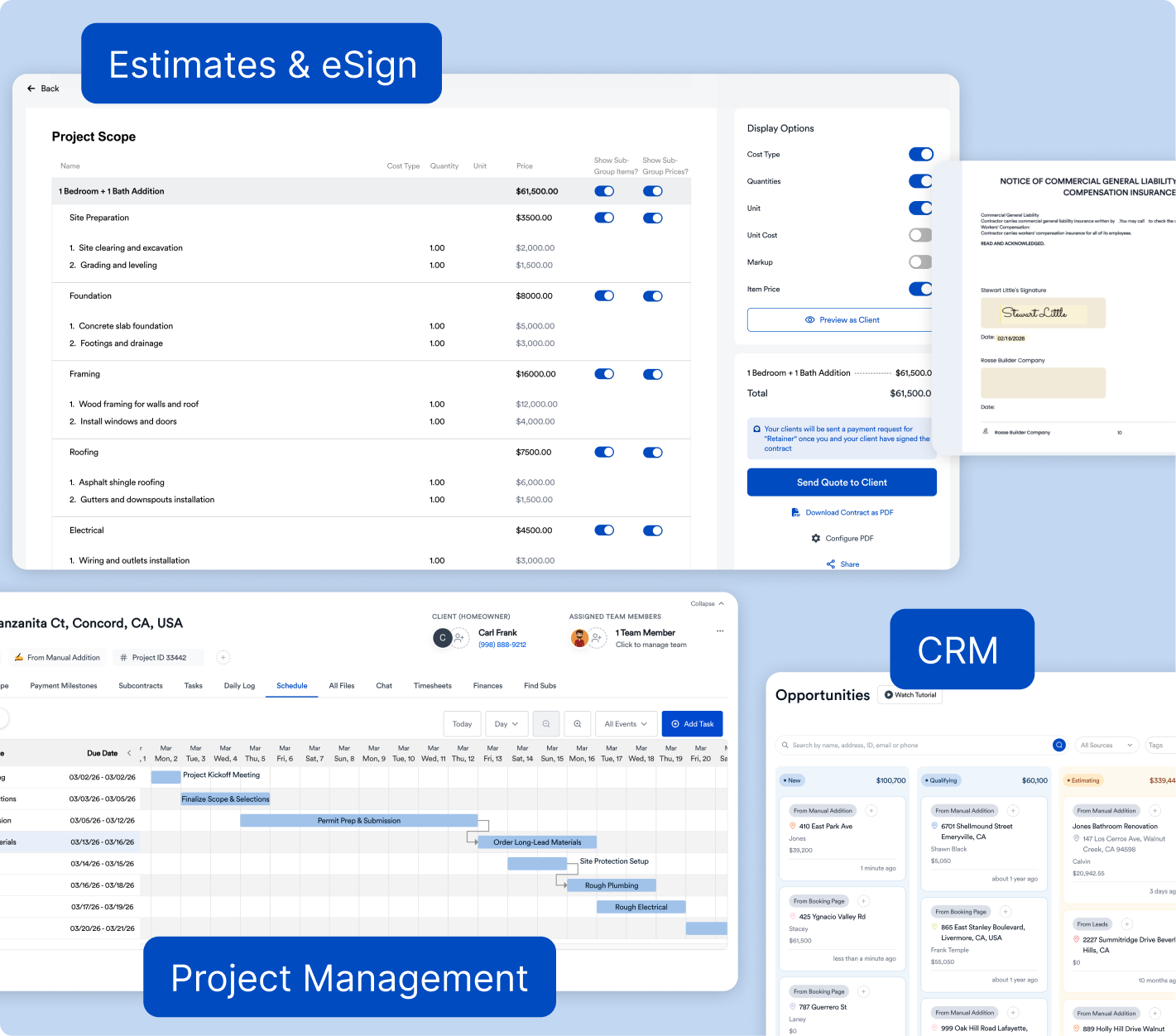
Eano Pro is designed to support this transition from manual management to structured operations.
It connects key parts of your business—CRM, estimating, scheduling, and project management—into one workflow.
That means:
- Leads turn into projects without re-entering information
- Estimates connect directly to job execution
- Tasks and schedules stay aligned across teams
Instead of managing disconnected pieces, you’re managing a system that holds everything together.
One of the biggest advantages is how it reduces reliance on any single person. The information lives in the platform, not in someone’s head or inbox.
That’s what makes it easier to grow without things falling apart.
A Real-World Shift
A contractor growing from a handful of jobs to running multiple crews found that the biggest challenge wasn’t getting work—it was keeping everything organized.
Before implementing a more structured system:
- They spent most of their time coordinating
- Small issues turned into bigger delays
- Communication required constant follow-up
After shifting to a centralized platform:
- Projects became easier to track
- Teams operated more independently
- Fewer things slipped through the cracks
The workload didn’t disappear—but it became manageable.
What Changes Day to Day
When systems improve, the day-to-day experience of running the business changes.
You’re not constantly reacting to problems or chasing updates. Instead, you have a clearer view of what’s happening and where your attention is actually needed.
Decisions become easier because you’re working with better information. Delegation becomes easier because expectations are clearer.
And growth starts to feel less like chaos and more like progress.
Why This Matters Before You Feel the Pain
A lot of contractors wait until things feel overwhelming before putting systems in place.
By then, it’s harder to untangle everything.
The better approach is to build structure before it’s absolutely necessary. That way, when more work comes in, your business can absorb it without breaking down.
Scaling isn’t just about handling more—it’s about handling more without things getting harder every time.
Final Thought
Growth in construction doesn’t usually fail because of a lack of opportunity—it fails because the business isn’t set up to support it.
When everything depends on constant coordination, memory, and hands-on involvement, there’s a natural limit to how much you can take on. Past that point, more work doesn’t create more profit—it creates more stress.
By building systems that organize how work gets done, contractors can shift from reacting to managing. That’s what allows a business to grow in a way that’s sustainable, predictable, and a lot less chaotic day to day.