Topics in this article

Share this post

Why Construction Proposal Software Is Replacing Word Docs and PDFs

John Shum
Sep 4, 2026
3
min read
Proposal delays cost small contractors jobs; adopting construction proposal software like Eano Pro streamlines the process and boosts efficiency.

You know time is money in construction. Proposal delays are a common, quiet reason jobs slip away — not because the price was wrong, but because a competitor's bid landed on the client's desk first. If you're still relying on Word docs and PDFs for project proposals, you're already feeling the squeeze.

It's rarely one dramatic failure that causes this. It's the accumulation of small friction points — a template that has to be hunted down, a pricing section that needs manual updating, a signature that has to be chased over email — each one adding a day here and a day there until the total delay is the difference between winning the job and losing it to whoever answered faster.

The squeeze rarely announces itself as a single lost job. It shows up as a client who went quiet after asking "when can you get me a number," and by the time the proposal was finally ready, they'd already signed with someone else.

Getting Beyond Manual Proposal Chaos

Every change order, scope adjustment, or price update means another round of PDF edits, email chains, and version confusion. It's easy for details to slip through the cracks. One mistake in a proposal can cost you the job — or worse, leave you footing the bill on project overruns.

With jobs piling up and owners demanding faster responses, the traditional way is holding teams back. That's where smarter tools come in.

The version-control problem is worth naming specifically, because it's usually the root cause behind the others. When a proposal lives as a file attachment, "final" is whichever copy someone happens to have open — there's no single record both the team and the client are actually looking at. A pricing correction made in one copy doesn't exist in the copy sitting in someone else's inbox.

Growth tends to expose this faster than anything else. One person building every proposal can hold the inconsistencies in their head and catch most of them before anything goes out. The moment a second estimator starts building proposals independently — using their own template, their own shortcuts, their own memory of what the standard terms are supposed to say — small differences start showing up in what clients receive, and nobody notices until a client points one out.

Why Construction Proposal Software Is a Smarter Move

Construction proposal software is built to solve the real headaches of creating, updating, and managing bids. Instead of juggling files and hoping everyone's working from the same version, everything lives in one place — online, accessible from any device.

With construction proposal software, you can track revisions, maintain a master library of templates, and automatically pull in up-to-date pricing and scope language. This not only saves hours every week, it reduces the risk of costly errors.

The templates themselves matter more than they might seem to. A proposal built from a maintained template starts from correct boilerplate, current terms, and consistent formatting every time — instead of starting from whichever old file someone can find and hoping the pricing section hasn't drifted out of date since the last time it was used.

Real-time pricing is the other piece that separates genuine proposal software from a nicer-looking document template. A template alone still requires someone to manually check that material costs and labor rates haven't moved since the last proposal went out. Pulling pricing directly from current job-costing data removes that manual check entirely — the number in the proposal is the current number, not last month's number with a hopeful assumption attached.

Eano Pro: A Purpose-Built Solution for Contractors
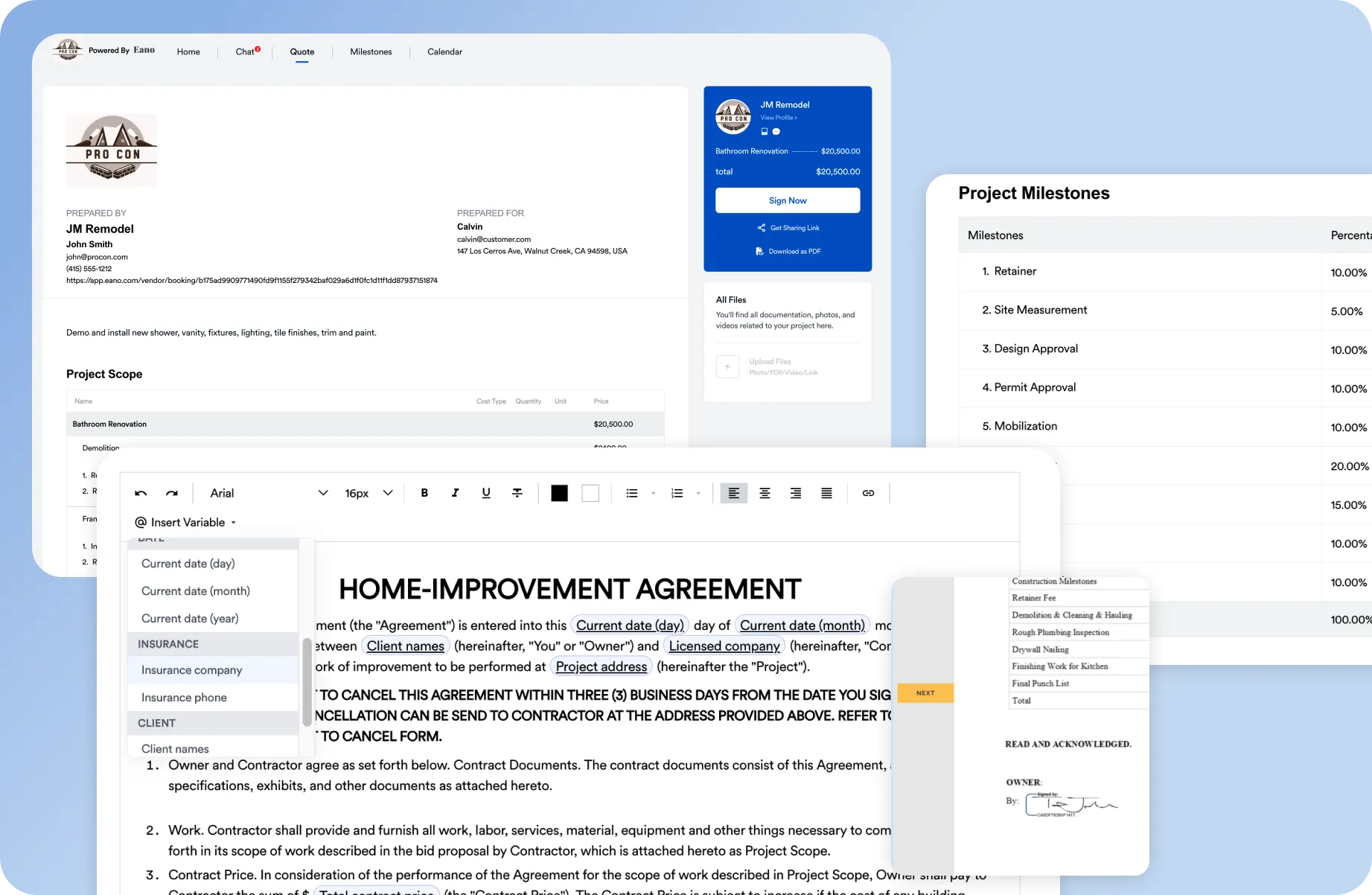
Eano Pro stands out because it's made for the way contractors actually work. You can start a proposal in minutes using customizable templates, drop in your company terms, and adjust pricing on the fly. No more formatting headaches. No more endless back-and-forth between estimating and project management.

Every proposal is tracked and timestamped. You can see who made changes, when, and why. That audit trail is peace of mind when a client has a question down the line.

The audit trail matters beyond just answering client questions, too. It's also what makes onboarding a new estimator faster — instead of trying to reconstruct how a senior team member typically prices a certain scope, a new hire can look at the actual history of past proposals and see the reasoning, not just the final number.

Formatting consistency is a smaller-sounding benefit that has an outsized effect on how a proposal reads to a client. A proposal that looks slightly different every time — different fonts, different section order, different level of detail — reads as improvised, even when the underlying pricing is careful and accurate. A template-driven system removes that variability by default, so the professionalism of the document doesn't depend on which estimator happened to build it or how much time they had that afternoon.

The Competitive Edge of Construction Proposal Software

Time spent on manual proposals is time lost from the field. With construction proposal software, approvals happen faster. You can send clients digital proposals to review and sign electronically, so projects move off your desk and into production without bottlenecks.

Clients get a professional, consistent experience every time. Your team gets more time to focus on execution, not paperwork. That's a win on both sides.

Speed matters most in exactly the moments it's hardest to deliver on — when a client is comparing several bids and the first complete, professional one in their inbox has a real head start, independent of price. A contractor who can turn a walkthrough into a polished proposal the same day is competing on responsiveness as much as on the number itself.

E-signatures deserve a specific mention here, since the mechanics of a signature are an easy thing to overlook as a source of delay. A proposal that has to be printed, signed, scanned, and emailed back adds days that have nothing to do with whether the client actually wants the job done — it's pure friction in the handoff between "yes" and a signed contract. Removing that step shortens the gap by more than most teams expect, simply because it removes a step that never needed to exist in the first place.

Overcoming Common Objections

Worried about switching from the old way? The best construction proposal software is built with contractors in mind — no steep learning curve, no IT department required. Eano Pro's platform is approachable, with walk-throughs and support, so even teams with no tech background can get up and running fast.

And because everything's cloud-based, you don't have to worry about lost files or outdated versions. Access proposals right from your phone or tablet, even on the jobsite.

A third objection worth addressing directly: what happens to years of existing proposal history and pricing knowledge during a switch? A reasonable platform doesn't ask a team to start from zero — existing templates and cost libraries import directly, so the switch preserves what already works rather than discarding it. The goal is removing the busywork around proposals, not relearning how to price a job.

The other common objection is cost, and it's worth answering directly rather than deflecting. The honest comparison isn't the subscription price against zero — it's the subscription price against the hours currently spent formatting documents, chasing signatures, and redoing proposals that had an outdated price slip through. For most teams, that comparison settles the question quickly.

Small Teams, Big Impact

If you're a small or midsize contractor, you don't have time for bloated software. You need something that just works — simple, fast, reliable. Construction proposal software lets you compete with bigger firms by making your operation more efficient and professional.

It's about leveling the playing field. When you can produce clear, accurate, and timely proposals, you're showing clients you take their business seriously. That's often what wins the job.

That leveling effect is worth sitting with for a moment. A five-person contracting outfit and a fifty-person one are both capable of sending out a proposal that looks equally polished, arrives equally fast, and reads equally professional to the client evaluating it — the size of the back office stops being the thing that determines how competitive a bid looks on arrival.

How Eano Pro Handles Proposals End to End

Beyond the general benefits of moving off Word docs and PDFs, Eano Pro specifically ties the proposal to everything that happens after a client signs it. The numbers in an accepted proposal become the numbers the schedule and budget are built from — not a static file that gets filed away once the ink is dry.

That connection is what actually prevents the most common source of post-signature disputes: a client questioning a cost that seems to have appeared from nowhere. Because a change order is logged and priced against the original proposal directly, there's a visible trail from the signed number to any number that changed after it, rather than two disconnected figures the client has to take on faith.

The proposal-to-job handoff also removes a specific failure point that shows up often in growing teams: the moment a signed deal has to be manually re-entered into whatever system tracks the actual work. When a proposal and the job that follows it live in the same platform, a signed contract becomes an active job automatically, with the scope, pricing, and client details already attached — nobody has to recreate what was already agreed to.

For a deeper look at building a proposal that holds up once a job starts — not just one that reads well on the page — see Eano Pro's guide to writing a construction proposal, and for teams managing growth specifically, how proposal management changes as a contracting team grows.

None of this requires overhauling how your team already works. Most contractors who switch describe the transition less as learning new software and more as finally being able to stop doing the same formatting and chasing work twice — the estimating and pricing judgment stays exactly the same; only the busywork around it changes.

Bringing It All Together

The industry is moving on from Word docs and PDFs, and for good reason. Too much is at stake to let proposal errors, delays, or confusion slow you down. Contractors who adopt purpose-built solutions like Eano Pro are staying ahead — winning more work, with less hassle.

Ready to see how easy it can be? Book a demo today and see Eano Pro in action for your team.
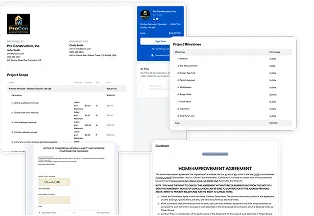
Get a Personalized Demo

See how Eano Pro can streamline your contracting workflow.

FAQs

Why do proposal delays cause lost jobs in construction?

Proposal delays cause lost jobs because owners demand faster responses and delays reduce competitiveness.

How does construction proposal software reduce errors compared to manual methods?

It centralizes templates, tracks revisions, and updates pricing automatically, reducing costly mistakes.

What features make Eano Pro suited for contractors' proposal needs?

Eano Pro offers customizable templates, pricing adjustments on the fly, and tracks every change with timestamps.

How does construction proposal software improve project approval times?

It enables faster digital client reviews and e-signatures, removing bottlenecks for quicker approvals.

Is construction proposal software difficult for small teams to adopt?

No, it has no steep learning curve, requires no IT support, and offers cloud access from any device.

Recent posts

Free Guide to AI Search

How Contractors Get Found in AI Search

Homeowners are asking ChatGPT and Google AI for a contractor before they ever open a search results page. This guide shows what those answers pull from, and how to make sure your business is in them.