
Top Construction Estimating Software in 2026: An Honest Comparison for Contractors
You've probably been there before: a promising project, a tight deadline to submit a bid, and an estimate that took you two full days to put together — only to lose the job by a thin margin, or worse, win it and discover you underpriced it. For most contractors, that pain is familiar. And it's exactly the problem that construction estimating software is supposed to solve.
But "supposed to" is doing a lot of work in that sentence. The market is crowded. There are dozens of platforms competing for your subscription, each promising faster bids, fewer errors, and more won projects. Some of those promises hold up. Others don't — at least not for your specific business size, trade, or workflow.
This guide cuts through the noise. We've evaluated the leading platforms in 2026 based on real contractor use cases, pricing transparency, and how well each tool fits different stages of business growth. We'll tell you who each software is actually built for, where it shines, and where it falls short.
Why Estimating Software Actually Matters in 2026
Before diving into individual platforms, it's worth grounding yourself in why this decision matters so much right now.
Research into capital project delivery shows that cost overruns in construction are alarmingly common — large projects routinely exceed budgets by significant margins, not because of bad crews or difficult clients, but because the estimating process missed costs, allowances, or schedule pressures from the very beginning. That's not a one-off failure. It's a systemic problem rooted in how most contractors build their numbers.
Key trends reshaping the space include the integration of artificial intelligence and machine learning for predictive analytics, cloud-based solutions enabling remote collaboration, mobile accessibility, and real-time data sharing. The latest engineering and construction industry outlook finds that AI is expected to drive a profound transformation across the industry over the next few years — including meaningful improvements in cost estimation, risk management, and decision-making. These aren't just nice-to-haves anymore — they're increasingly the baseline that competitive contractors expect from their tools.
Contractors use estimating software to pull local pricing data, ensuring the quotes they provide to potential clients are current and competitive, which can directly help them win more bids. In an environment where material costs fluctuate and labor markets remain tight, that real-time pricing capability is no longer a luxury.
The bottom line: if your estimating process lives in a spreadsheet, you're likely leaving money on the table — or spending far more time on bids than you need to.
What to Look for Before Choosing a Platform
Not all estimating software is built for the same contractor. Before evaluating any individual tool, you need to be honest about your own situation:
Project type and trade. A residential remodeler has fundamentally different needs from a heavy civil GC bidding DOT work. The features that matter — pre-built assemblies, takeoff tools, cost databases — vary significantly by trade and project scale.
Team size. A solo estimator working from a home office needs a completely different workflow than a preconstruction department managing 30 simultaneous bids.
Deployment preference. Cloud-based platforms have become the standard for teams that need multiple users accessing estimates simultaneously, while desktop applications still appeal to individual estimators who want full control and offline capability.
Integration requirements. The best construction estimating software allows for a smooth flow of data between various platforms, improving overall project management efficiency — look for systems that work well with popular project management tools, accounting software, and CRM systems. Eano, for example, connects natively with QuickBooks, Angi, WhatsApp, and Zapier, making data handoffs seamless across your existing stack.
Cost database quality. Ask every vendor: How often is the pricing data updated? Is it localized to your region? Can you customize it with your own historical rates?
With those questions in hand, let's look at the platforms worth your attention in 2026.
The Top Construction Estimating Platforms in 2026
1. Eano — Best for Small-to-Mid-Size General Contractors Who Want Speed and Simplicity
If you're a growing GC or remodeler tired of stitching together spreadsheets, proposals, and contracts across three different tools, Eano is worth a serious look. Eano's estimating platform is purpose-built to move contractors from job notes to client-ready proposals as fast as possible — without the bloat that makes enterprise software painful to learn.
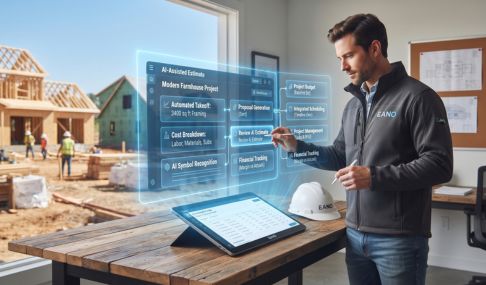
The platform lets you define job scope and generate construction project costing at the line-item level, covering materials, labor, and subcontractor costs, so you always know where your budget stands before and during the job. AI-powered tools automate line item creation, and pre-built templates let you move fast on common job types without starting from scratch every time.
Where Eano genuinely differentiates itself is in the end-to-end workflow. Most estimating software stops at the estimate. Eano connects it directly to proposals (with digital signatures), contracts, project management, and client communication — all inside a single platform. Contractors using the platform report saving 15 or more hours per estimate compared to manual processes.
For small contractors, accurate estimates are crucial for profitability and credibility. Switching to dedicated estimating software like Eano Pro streamlines the process, enhances efficiency, and supports business growth by minimizing manual errors.
For contractors evaluating AI tools specifically, Eano's AI estimating feature generates detailed, line-itemized quotes in seconds based on a project description — handling everything from bathroom remodels to backyard ADUs. It's not a replacement for your estimator's judgment, but it dramatically compresses the time between a client inquiry and a professional proposal.
Best for: Residential GCs, remodelers, and small-to-mid-size commercial contractors who want a fast, integrated platform without a steep learning curve.
Watch out for: If you're bidding heavy civil, infrastructure, or highly complex commercial projects, you may need a platform with deeper enterprise cost modeling.
2. ProEst — Best for Commercial GCs Who Need Cloud-Based Automation
ProEst takes the top spot in several independent rankings for its cloud-based automation of takeoffs, bid management, and real-time cost tracking, making it ideal for accurate and efficient bidding across various project scales.
ProEst is particularly strong for commercial GCs who need built-in RSMeans cost data, pre-built assemblies, and the ability to manage multiple bids simultaneously across a team. The platform's integration with project management and accounting tools is well-regarded, and its reporting capabilities are robust enough for firms that need to track estimating performance over time.
The trade-off is price and complexity. ProEst sits in the higher-cost tier, and onboarding requires real investment of time. For firms that can absorb that curve, the payoff is meaningful. For smaller operations, the overhead may not be worth it.
Best for: Mid-market to large commercial GCs with a dedicated preconstruction team.
3. STACK — Best for Trade Contractors Doing Digital Takeoffs
STACK is a cloud-based construction software built for general contractors, specialty trades, and estimating firms to complete digital takeoffs and cost estimations. By allowing users to predefine assemblies with itemized materials, labor rates, and cost markups, STACK ensures that every estimate is completed quickly and turns a profit.
STACK's auto-count feature is a particular standout — it identifies repetitive items like doors, windows, and outlets automatically, while auto-fill applies measurements and quantities to flooring and drywall. For trade contractors who live and die by accurate quantity takeoffs, this saves hours per bid.
The platform is also popular with drywall, concrete, and roofing contractors who need trade-specific templates without paying for enterprise-level features they'll never use.
Best for: Specialty trade contractors who need fast, accurate digital takeoffs with solid cost estimation built in.
4. PlanSwift — Best Standalone Takeoff Tool
PlanSwift is a digital takeoff and estimating software that enables fast measurements and cost calculations directly from digital plans. It's been around long enough to have a massive user base and a well-established workflow, and it remains one of the most recommended options for estimators who want a focused, reliable takeoff tool without a full platform ecosystem attached.
PlanSwift earns strong marks for its user-friendly digital takeoff tools for PDFs and CAD files, making it well-suited for precise material and labor calculations.
The limitation is that PlanSwift is primarily a takeoff tool, not a full estimating-through-proposal platform. You'll likely need to integrate it with other software to complete your full workflow.
Best for: Estimators across most trades who want a dedicated, proven takeoff tool and don't mind using separate software for the rest of the bid process.
5. Buildxact — Best for Residential Builders and Small Contractors
Buildxact is a cloud-based estimating and job management platform built specifically for small to medium-sized contractors. It simplifies quoting, purchasing, and scheduling in one place, helping streamline everyday operations. Its intuitive design makes it easy to use, even for contractors who aren't tech-savvy.
Buildxact is often the first platform residential builders move to when they outgrow spreadsheets. Setup is fast, pricing is accessible, and the learning curve is manageable. It won't satisfy a large commercial operation's needs, but for home builders and renovators, it covers the essentials well.
Best for: Residential home builders and smaller renovation firms making their first move from spreadsheets to dedicated software.
6. Sage Estimating — Best for Large Commercial and Enterprise Projects
Sage Estimating is a high-powered solution for contractors who need advanced estimating capabilities backed by automation and precision. It's built for both residential and commercial projects, with specialized tools for various trades. The platform uses AI and cost databases to create fast, highly accurate estimates.
Sage's biggest advantage is depth. Its integration with Sage 300 and other enterprise accounting systems makes it a natural fit for large firms that need estimating tightly coupled with financial reporting. The cost databases are extensive, and the platform can handle the complexity of large multi-trade projects.
The downside is predictable: enterprise price tag, enterprise implementation time, and an interface that rewards investment in training.
Best for: Large commercial GCs and enterprise contractors with dedicated estimating departments and existing Sage accounting infrastructure.
7. Bluebeam Revu — Best for PDF-Based Collaboration and Takeoffs
Bluebeam Revu allows you to digitally estimate from blueprints while offering a variety of functions to create and modify PDF files — and users rely on it for a wide range of PDF management tasks including editing, merging, splitting, and marking up documents with precision.
Bluebeam is less of a standalone estimating platform and more of a precision document and takeoff tool that integrates into larger workflows. It's particularly popular in commercial construction environments where teams are collaborating on complex drawing sets and need a reliable, precise markup and measurement tool.
Best for: Commercial contractors and estimating teams who work heavily with large drawing sets and need robust PDF markup alongside takeoff capability.
8. InEight Estimate — Best for Heavy Civil and Infrastructure
InEight is an enterprise-grade construction management platform built for large, complex projects. Its estimating module supports contractors working across infrastructure, industrial, utility, and heavy civil projects. Estimators can build bottom-up or top-down estimates using flexible work breakdown structures and reusable templates that mirror the way projects are delivered in the field.
InEight handles deep, multi-layered cost structures and connects directly with the broader project controls suite, so estimates transition smoothly into project budgets and schedules. For contractors doing the kind of work most platforms can't handle, InEight is purpose-built.
Best for: Heavy civil, infrastructure, utility, and industrial contractors with complex, multi-stakeholder project requirements.
Head-to-Head: How the Platforms Stack Up
Here's a quick reference comparison across the factors that matter most for most contractors:
The AI Question: Hype vs. Reality
Every major platform is now claiming AI capabilities, and it's worth separating the genuine value from the marketing noise.
AI construction estimating software uses computer vision and machine learning to read construction drawings and pull quantities automatically — wall lengths, floor areas, window and door counts, and roof surfaces. Those quantities then feed into a cost library to build an estimate. The AI does the measurement work; your estimator still handles scope interpretation, general conditions, implied items, and everything that requires judgment beyond what's drawn on the page.
Industry analysis on AI and automation in estimating confirms that these tools significantly improve both the speed and accuracy of manual estimating tasks, with capabilities that can automatically detect discrepancies in quantity data and reduce errors across the takeoff process.
On residential and light commercial jobs with clean drawings, most platforms run 90–95% accuracy on automated quantity takeoffs. On complex commercial work with heavy MEP coordination, accuracy drops and human review becomes more critical.
The practical implication: AI estimating tools earn their keep most clearly on residential and light commercial work with clean CAD drawings. The further you move toward complex commercial, MEP-heavy, or heavily coordinated work, the more your estimator has to add on top of what the software produces. AI compresses time. It doesn't replace judgment.
The best use of free access is testing a real project, comparing outputs to manual takeoffs, and checking workflow integration. Don't evaluate AI estimating tools on demo data — test them on your actual jobs with your actual drawings. Eano makes this easy with a no-obligation free trial that lets you run your own project through the system before committing.
Common Mistakes Contractors Make When Choosing Estimating Software
Choosing features instead of fit. A platform with 200 features you won't use is worse than a focused platform with 20 features that match exactly how you work.
Skipping the trial on real jobs. Most reputable vendors offer free trials or demo versions — take advantage of these before committing, and test the software against a real project you have already estimated manually so you can verify the results.
Underestimating onboarding time. Every new platform requires your team to change how they work. Budget for training, expect a dip in productivity during the transition, and factor that into your decision. Eano addresses this directly with one-to-one personalized onboarding sessions included in every subscription.
Ignoring the proposal and contract side. Estimating doesn't end when you finish the cost sheet. If your software can't generate a professional proposal quickly, you're adding friction at a critical moment in the sales process. The right system helps you turn bids into winning proposals and keeps your whole team aligned from bid day through project completion.
Treating price as the primary filter. Cheap software that causes you to underbid one project will cost more than a year of subscription fees. Evaluate total cost — including the cost of errors, re-bids, and project overruns — not just the monthly charge.
Making Your Decision: A Practical Framework
Rather than trying to pick the "best" platform in the abstract, work through this sequence:
- Write down your top 3 pain points in your current estimating process. Are you spending too long building estimates from scratch? Losing jobs because proposals look unprofessional? Discovering missed costs mid-project? The right software solves your actual problems.
- Identify your non-negotiables. What integrations do you need? Do you require offline capability? Is mobile access essential for your field team? Eano's timesheet and field tracking tools may matter as much to your decision as the estimating engine itself.
- Shortlist 2–3 platforms that match your trade, size, and workflow.
- Run trials on real jobs — not demos. Compare the output to what you would have produced manually. Measure time. Evaluate accuracy.
- Talk to other contractors in your trade who use the software. No review site can replace a 15-minute conversation with someone who runs a similar business.
The Bottom Line
There's no single best construction estimating software in 2026. The right answer depends entirely on your trade, your team size, your project types, and how your business currently works.
What we can say with confidence: the gap between contractors using modern estimating software and those still relying on spreadsheets is widening. The tools have improved significantly. The integration between estimating, proposals, project management, and financials is tighter than it's ever been. And AI capabilities, used correctly, are genuinely compressing the time it takes to go from site visit to signed contract.
For small-to-mid-size GCs and remodelers looking for the fastest path from inquiry to won job, Eano's combination of AI estimating, integrated proposals, and project management makes it worth a serious evaluation. For large commercial GCs with enterprise requirements, ProEst or Sage Estimating will likely be better fits. Trade contractors doing high-volume takeoffs should look hard at STACK or PlanSwift.
The best thing you can do right now is pick two platforms from this list, run a real trial on a project you've already estimated, and compare the results. That test will tell you more than any comparison guide.