How Contractors Should Really Be Managing Construction Proposals
Winning new work is hard enough — wasting hours on slow, error-prone proposals just adds to the headache. With margins tight and competition fierce, dialing in your proposal process isn't a luxury — it's essential. Win rates on competitively bid construction work commonly run in the 10–25% range, and negotiated or repeat-client work can climb to 30–50% or higher, according to ranges commonly cited by Engineering News-Record. In a market where every bid counts that much, a proposal that goes out late or looks unpolished is giving away an edge you didn't need to give away.
That edge is easy to underestimate until you've lost a job to it. A client comparing bids from several contractors isn't only comparing price — they're comparing how quickly and how confidently each one turned a walkthrough into a real number. Two contractors can be equally skilled and equally fair on price and still lose or win the job based on which one answered first.
Why Most Contractors Struggle with Proposals
Most construction businesses start out with a mix of spreadsheets, Word docs, and email chains to handle proposals. It works for a while — until project volume ramps up. Suddenly, you're hunting for old templates, juggling version control, and chasing down missing scope details. Worse, mistakes start slipping through. Forgotten line items. Missed client requirements. All of this costs you time, money, and sometimes the job itself.
Manual proposal processes make it hard to:
- Track revisions and approvals
- Respond quickly to bid opportunities
- Avoid costly errors or omissions
None of this is really a skill problem. An experienced estimator usually knows what a job should cost — the actual bottleneck is almost always the mechanical process of getting that number into a clean, consistent document a client can review and sign, especially once more than one person is building proposals for the same company.
Growth is usually what exposes this problem, not carelessness. A founder handling every proposal personally can hold most of the details in their head and catch an inconsistency before it goes out. The moment a second estimator starts building proposals independently — with their own shortcuts and their own memory of what the standard terms are supposed to say — small differences start reaching clients, and nobody notices until one points it out.
The Real Impact: Time, Money, and Your Reputation
A clunky proposal workflow isn't just an inconvenience. Slow turnaround times can mean missed deadlines and lost bids. Inaccurate estimates can squeeze your profits or expose you to costly change orders later. And seeing competitors deliver clean, professional proposals while yours lag behind is never a good look.
If any of this sounds familiar, you're not alone. But there's a better way to approach construction proposal management and put those problems behind you.
The reputational cost compounds in a way that's easy to miss. A single slow or sloppy proposal might not sink a relationship with a client, but a pattern of them — noticed by the same repeat clients or the same referral network over a few years — quietly changes how a contractor is perceived, independent of the actual quality of the work being built.
There's also a direct financial cost that's easier to measure: a proposal delayed by a week isn't free even when it eventually wins the job. Estimating time gets tied up longer than it needs to, cash flow projections slip, and the crew scheduled to start that job sits a week further out than it could have. None of that shows up as a single line item, but it adds up across a season of bids.
How Digital Tools Are Changing Construction Proposal Management
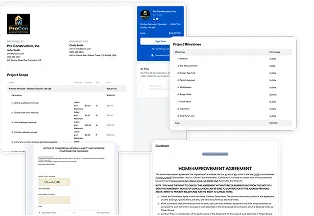
Modern construction proposal management platforms are built for contractors, not accountants. They organize all your proposal templates, scope items, and pricing in one place. Creating a new proposal takes minutes, not hours. Revision history and approval workflows keep everyone on the same page.
Tools like construction proposal management by Eano Pro are designed for crews and small businesses that don't have time for complicated software. They let you:
- Auto-fill material and labor rates
- Track every change, comment, and approval
- Instantly generate polished PDFs ready to send
With the right system, you can respond to RFPs faster, reduce mistakes, and give clients a more professional experience from the start.
The auto-fill piece is worth dwelling on, because manual re-entry is exactly where a proposal drifts out of sync with the estimate it was supposed to reflect. A material price that changes in the estimate but not in the proposal document is a discrepancy waiting to be noticed — usually by the client, and usually at the worst possible moment.
Templates matter here too, in a way that's easy to undervalue. A proposal built from a maintained template starts from correct boilerplate and current terms every time, rather than from whichever old file someone can find and hope hasn't drifted out of date since the last time it was used. That consistency is what keeps a proposal from reading as improvised, even under deadline pressure.
What Makes Eano Pro Stand Out for Contractors?
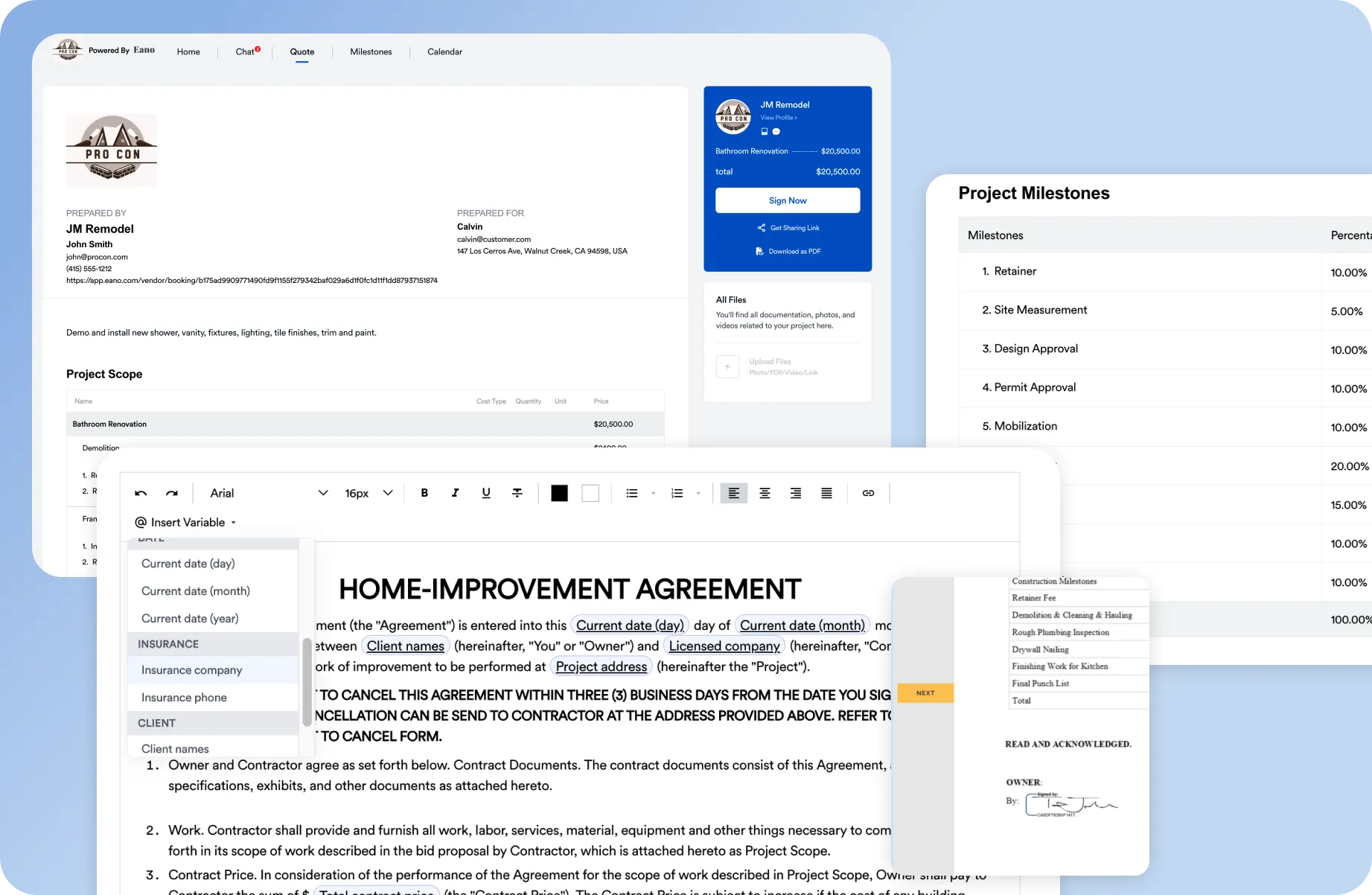
Eano Pro is built specifically for general contractors and small-to-midsize teams. No unnecessary features, no confusing menus — just straightforward tools that get proposals out the door quickly and accurately. Eano Pro streamlines your construction proposal management process so your team can focus on winning jobs, not wrestling with paperwork.
Here's what sets Eano Pro apart:
- Flexible templates for different project types
- Real-time collaboration for teams
- Integrated approval workflows and version control
- Reliable, cloud-based access from anywhere
Because proposals, estimates, and job costing all live in the same platform, a contractor moving to Eano Pro isn't stitching together separate tools and hoping the numbers stay in sync between them. That matters more than it sounds: a workflow that requires double entry between systems tends to get abandoned within a few weeks by a busy team, no matter how good any one piece of it is on its own.
Cloud-based access earns its place on this list for a specific reason: a lot of proposal work genuinely happens away from a desk — during a walkthrough, in a truck between job sites, at a kitchen table with a client asking a follow-up question. A tool that only works well from an office computer is a tool the field never fully adopts, and it stays an office-only system the rest of the team works around.
Every proposal built in Eano Pro is also tracked and timestamped automatically, which turns onboarding a new estimator into something faster than it usually is. Instead of trying to reconstruct how a senior team member typically prices a certain type of job, a new hire can look at the actual history of past proposals and see the reasoning behind them, not just the final numbers.
Common Pitfalls Eano Pro Helps You Avoid
When contractors try to upgrade their proposal process, the biggest risks are overcomplicating things or using generic office software. Eano Pro is purpose-built for the way construction teams really work, avoiding:
- Manual re-entry of scope and pricing data
- Losing track of updates or feedback
- Inconsistent branding and document quality
With everything organized in one platform, your proposals stay professional, accurate, and easy to update as project scope changes.
Inconsistent branding and formatting is easy to dismiss as a cosmetic issue, but it has a real effect on how a proposal reads to a client. A document that looks slightly different every time — different fonts, different section order, different level of detail — comes across as improvised, even when the underlying pricing behind it is careful and accurate. A template-driven system removes that variability without anyone having to think about it.
Losing track of updates or feedback deserves its own mention, since it's often the pitfall that causes the most friction with a client directly. When a revision request gets handled over a phone call and never makes it back into the actual document, the client is left wondering whether their change was heard at all — even when it genuinely was. A single, shared, updated record removes that doubt.
Getting More from Every Proposal
Streamlining your construction proposal management isn't just about saving time. It's about:
- Reducing costly errors and disputes down the road
- Freeing up you and your team for higher-value work
- Increasing your win rate on bids by responding faster
The right approach to construction proposal management lets you focus on building, not paperwork. And that's how the best contractors stay ahead.
These three benefits reinforce each other more than they might first appear. Fewer disputes means less time spent resolving them after the fact, which is exactly the higher-value work the second bullet is describing — and a team with more time back tends to respond to new bid opportunities faster, which is the third bullet. None of this is three separate improvements; it's really one improvement showing up in three places.
What to Look for When Choosing Proposal Software
Not every tool sold as "proposal software" was actually built around how construction proposals work. Before switching, it's worth confirming that pricing pulls automatically from the same numbers behind the estimate — rather than requiring a second, manual entry — and that a client can actually review and sign from a phone rather than the process still ending in a printed and scanned PDF.
Onboarding speed matters just as much, especially for a small team where the estimator is often also the one running jobs in the field. A tool that takes weeks to configure before it produces a usable proposal is solving the wrong problem — it's moving the time cost earlier instead of removing it. The better test during any demo is how long it actually takes to build one real proposal from a job the contractor has already priced, not how many features appear on a pricing page.
Support and existing data also deserve a look before signing on. A platform that leaves a contractor to figure things out alone, with no real onboarding, tends to get used inconsistently across a team — which recreates the exact version-control problem the switch was supposed to solve. And a platform that can't import existing templates and pricing history is asking a team to start over rather than build on what already works.
Ready to See Eano Pro in Action?
Contractors who take proposal management seriously win more work, with less stress. Eano Pro puts the tools you need right at your fingertips — no hassle, no headaches.
Switching from a manual process is usually less disruptive than it sounds. Existing templates and pricing typically import directly, so the transition preserves what already works instead of asking a team to relearn how they price a job. For a closer look at moving off Word docs and PDFs specifically, see why construction proposal software is replacing Word docs and PDFs, and for the step-by-step path from a priced estimate to a signed contract, Eano Pro's guide to getting from estimate to approved contract.
Book a demo now and see how Eano Pro can transform your proposal process: Schedule a demo.