
Construction Takeoff and Estimating Software: Why the Two Need to Work Together
Most contractors don't lose bids because their pricing is wrong. They lose them because the process of getting to a price takes too long, introduces errors at the wrong moments, and creates proposals that don't inspire confidence. The problem usually isn't the number — it's the workflow that produced it.
If you're still running takeoff in one tool and estimating in another, you already know the friction. You've lived it: the CSV exports, the reformatted line items, the version that didn't make it over from the last drawing revision. That workflow made sense when no single platform handled both steps well. That's no longer the case.
In 2026, the question isn't whether to use construction takeoff and estimating software — it's whether the platform you're on actually connects those two steps, or just makes the handoff slightly less painful. This article breaks down where that gap costs you the most, what genuine integration looks like, and how to evaluate whether a platform is actually built for the way your business wins work.
The Real Cost of the Takeoff-to-Estimate Gap
The handoff between takeoff and estimating is the single most error-prone moment in the estimating workflow. Not because estimators aren't careful — but because the handoff requires manual restructuring of data across two systems that weren't designed to talk to each other.
Here's what goes wrong in that gap:
Quantities get reformatted and corrupted. When you export a quantity list from a takeoff tool and import it into an estimating spreadsheet, the structure almost never maps cleanly. Line items get renamed, units get converted, categories get consolidated. Each adjustment is a decision point where an error can enter — and because those adjustments happen quickly, they often go unnoticed until a client questions a number.
Version control becomes a manual job. Your takeoff reflects the drawing set at a moment in time. When a revision comes in — which it always does — the updated takeoff exists in one file and the estimate exists in another. Reconciling them requires someone to go line by line. In practice, many teams don't do this fully. They patch what's obvious and move on. That creates estimates that reflect an older version of the project scope.
Traceability disappears. In a fragmented system, the estimate says "Exterior framing: $11,200" and there's no practical way to click through and see what footage that number came from, on which sheet, in which elevation. When a client, PM, or subcontractor questions the number, you're digging through two systems to reconstruct the source.
Proposal production becomes a third job. Even if your takeoff and estimating tools are reasonably connected, most contractors still have to manually build the client-facing proposal — formatting the estimate into a Word document or PDF and hoping nothing gets transposed in the process.
Integrated construction takeoff and estimating software collapses all of these steps. Quantities flow into the estimate automatically. The estimate becomes the proposal without reformatting. Every line item is traceable to the element on the drawing it came from. That's not a minor improvement in efficiency — it's a different category of workflow.
What AI Changes About the Takeoff Step Specifically
The takeoff step has historically been the biggest time sink in estimating — not because it's intellectually complex, but because it's mechanical and time-consuming to do manually. Counting windows, measuring wall linear footage, calculating roof square footage across an irregular plan: a skilled estimator can do it accurately, but it takes hours.
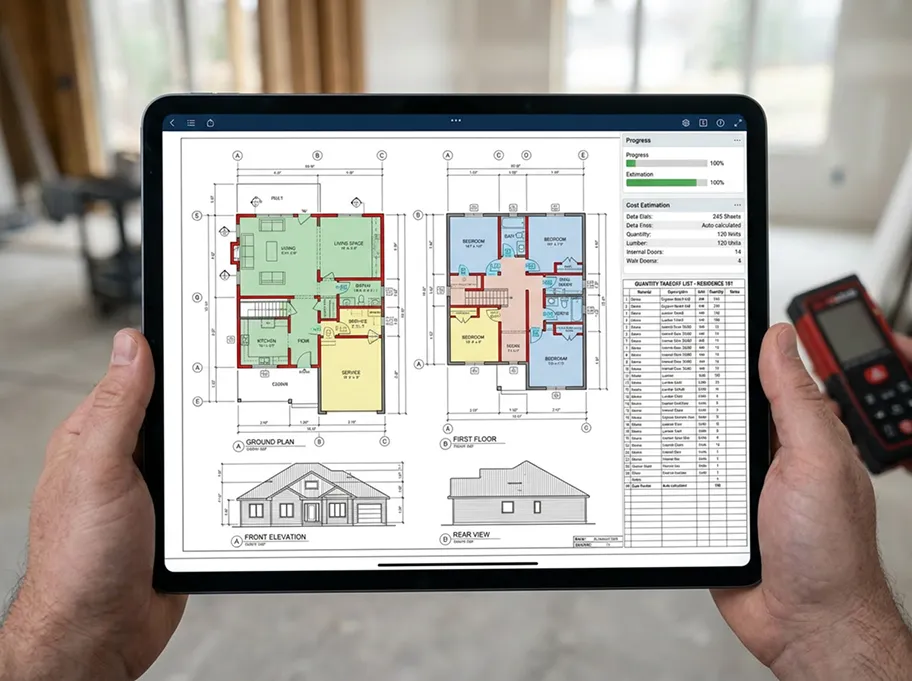
AI-powered takeoff changes the time math fundamentally. On a clean residential plan set, AI extraction of architectural quantities — walls, openings, floors, ceilings, roofs — now takes 15 to 20 minutes. The estimator's job shifts from doing the measurement to reviewing and validating it, which takes 30 to 45 minutes on most projects.
That's not a 10% improvement. It's a 70–80% reduction in the time spent on the measurement step.
But — and this is the part most platforms miss — the AI takeoff only delivers its full value if the output flows directly into the estimate. If the extracted quantities still need to be exported, reformatted, and imported into a separate estimating tool, you've solved the measurement problem while leaving the workflow problem intact.
The right question to ask about any AI construction takeoff tool isn't just "how accurate is the extraction?" It's: "Where do those quantities go once they're extracted, and what has to happen manually between extraction and a finished estimate?"
According to the National Institute of Standards and Technology, poor information flow and data re-entry in the construction industry costs the U.S. economy billions annually in project inefficiency — a problem that starts in the estimating phase and compounds downstream.
What True Integration Actually Looks Like
The term "integrated" gets used loosely by software vendors. Here's how to distinguish real integration from marketing language.
Live data connection, not a point-in-time export. In a truly integrated system, when a quantity changes in the takeoff — because of a drawing revision, a field correction, or a scope adjustment — the estimate updates automatically. If the process requires you to re-export and re-import, the data connection is not live. It's a better-than-manual handoff, but it's not integration.
Bidirectional traceability. From any line item in the estimate, you should be able to click through and see the element on the drawing it came from. From any element in the drawing, you should be able to see which line items it contributed to. This traceability is what makes the estimate reviewable, defensible, and auditable when a client or PM questions a number.
Assembly and unit cost libraries built in. Quantities arriving in the estimate need pricing logic to become a bid. A genuine estimating module includes assembly rates, labor productivity factors, and material unit costs that the platform maintains and you can customize. Without this, "integrated estimating" just means quantities arriving in a spreadsheet you still have to price manually.
Proposal output without reformatting. The estimate and the client-facing proposal should be the same data structure, not two separate documents. If producing the proposal requires copying numbers from the estimating module into a Word template, there's a workflow gap at the back end of the process that the platform hasn't solved.
Revision management built into the workflow. When drawing revisions come in — and they always do — the platform should support re-running the AI takeoff on updated sheets, flagging what changed, and propagating those changes to the estimate with a clear audit trail.
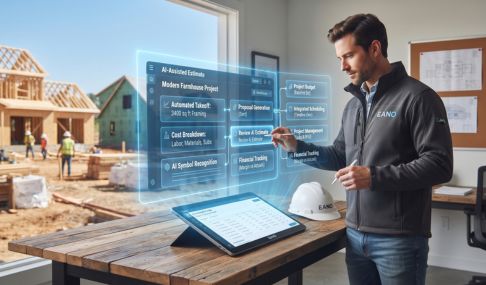
Eano's AI estimate platform is built around this connected workflow. Quantities extracted by the AI flow directly into the estimate, the estimate generates the proposal, and the proposal can become the project budget — all within one system, without a single CSV in between.
Platform Comparison: What the Market Looks Like in 2026
The distinction that separates the top tier from the rest: platforms like Eano are built so that takeoff, estimating, proposals, and project management share a single data model. The others require at least one manual data transfer to complete the workflow.
For residential GCs specifically, the combination of AI-powered takeoff with a fully integrated estimating workflow and connected proposal generation isn't just a time saver — it's what allows smaller teams to compete at bid volumes that would otherwise require additional estimating staff.
The Time Math: What Integration Is Actually Worth
Here's what the difference looks like on a typical residential remodel bid, run by a two-person estimating team:
Fragmented workflow (AI or manual takeoff + separate estimating tool):
- Drawing upload and setup: 15 minutes
- Takeoff (manual) or AI takeoff + export: 2.5–4 hours
- Reformat and import into estimating tool: 30–45 minutes
- Price line items in estimating tool: 1.5–2 hours
- Build proposal in Word or Google Docs: 45 minutes–1 hour
- Total: 5.5–8 hours per bid
Integrated AI workflow on Eano:
- Drawing upload: 10 minutes
- AI extraction: 15–20 minutes
- Estimator review and validation: 30–45 minutes
- Review and finalize pricing: 45 minutes–1 hour
- Proposal generated from estimate: 5–10 minutes
- Total: 1.75–2.5 hours per bid
At eight bids per month, that's the difference between 44–64 hours of estimating time and 14–20 hours. That's 30–45 hours per month recovered — time that can go toward more bids, toward project management, or toward work that currently isn't getting done because the estimating load is too heavy.
The Research Institute of America has noted that construction estimating errors and rework are among the leading contributors to project cost overruns. The integrated workflow reduces the manual touchpoints where those errors originate.
What to Look Out for When Evaluating Platforms
Test on your own drawings, not demo plans. Every platform performs well on the clean, well-formatted plans used in sales demos. Your projects may include scanned drawings, hand-drafted details, partial plan sets, or mixed-format submissions. Always run a real project through any platform you're seriously evaluating before making a decision.
Ask exactly what happens when a drawing is revised. This is the question that separates truly integrated platforms from systems with good import/export. When a drawing revision comes in and you update the takeoff, what happens to the estimate? Does it update automatically? Does it require a new export? How does the system track what changed? The answer tells you more about the platform than any feature list.
Don't evaluate the takeoff step in isolation. AI takeoff that doesn't connect to integrated estimating solves the measurement problem while leaving the workflow problem in place. The value is in the connected system — measurement to estimate to proposal to project budget, without friction between steps.
Understand the pricing logic behind the estimate. A platform that extracts quantities accurately but doesn't have a maintained assembly and unit cost library still requires significant manual pricing work. Ask whether the platform maintains pricing databases, how they're updated, and how customizable they are for your labor rates and supplier pricing.
How Eano Approaches This Differently
.webp)
Most construction software companies built estimating tools and then added takeoff later, or built takeoff tools and then tried to connect them to estimating platforms they didn't design. Eano built the workflow from the beginning as a connected system — takeoff, estimating, proposals, and project management sharing the same data from the start.
For residential GCs and remodelers, that matters for a specific reason: the volume and pace of residential work requires a faster bid cycle than commercial. A GC managing five to fifteen active bids per month can't afford a workflow where each bid takes six to eight hours to produce. The math doesn't work for the business, and it doesn't work for the team.
Eano's AI takeoff takes the measurement step from hours to minutes. The integrated estimate pre-populates from the takeoff without data transfer. The proposal is generated from the estimate, not assembled separately. And because the whole workflow lives in one system, every number in the proposal is traceable back to its source measurement on the drawing.
That's also why Eano's platform connects naturally to construction project management — because once the proposal is accepted, the estimate shouldn't live in a separate system from the project budget. The bid that wins the work should become the baseline against which the project is managed, without re-entry.
The Construction Industry Institute has consistently identified workflow integration as one of the highest-leverage improvements available to contractors — not because individual tools are insufficient, but because the gaps between them are where time and accuracy go to die.
Ready to See the Workflow?
If your current estimating process involves more than one handoff between takeoff and proposal, there's a version of this that runs in a fraction of the time — and produces a more accurate, more defensible result.
Book a demo with Eano to see the connected workflow on a project similar to what you're currently bidding. Or explore AI takeoff and integrated estimating on the platform directly.
The contractors winning the most work in 2026 aren't running better individual tools. They're running a connected workflow — where every step from drawing upload to signed proposal happens without friction, and where the number in the proposal is always traceable to where it came from.
That's what Eano is built to be.