The 2026 Guide to AI Construction Software: Trends, Adoption, and Best Practices
Running a construction business is all about keeping projects on time and on budget. If you're juggling jobs, paperwork, and field crews, new technology can either be a headache or your best tool. Here's how the latest digital solutions can make your day smoother — and your jobs more profitable.
The gap between firms that adopt these tools well and firms that don't is widening faster than it looks from the outside. It's rarely about budget — it's about which contractors have actually built the software into how they run a job, versus which ones bought a license and let it sit mostly unused.
Why Construction Teams Are Turning to Smart Software
Construction companies face tighter margins and higher client expectations every year. Manual estimating, disorganized files, and missed deadlines cost real money. That's why more general contractors are looking for solutions that help them work smarter, not just harder.
Platforms like Eano Pro are designed specifically for construction management. They help teams eliminate busywork, cut down on errors, and keep everyone — from owners to subs — on the same page. The main goal: make life simpler while protecting your bottom line.
What's changed in the last couple of years isn't the underlying need — contractors have always needed accurate numbers and clear communication. What's changed is how much of that work software can now do on its own, rather than requiring someone to manually enter and re-enter the same information across three different tools.
It's also worth being clear about what's still the same. Software doesn't replace the judgment of someone who's walked a hundred similar jobsites — it removes the busywork that used to eat the hours that judgment needed to actually get applied. A tool that promises to replace estimating expertise entirely is overselling; a tool that gives an experienced estimator their afternoons back is solving a real problem.
How AI Construction Software Is Shaping the Industry
The adoption of AI construction software is no longer just for big-budget projects or tech-focused firms. Small and midsize contractors are seeing the value in tools that automate estimates, analyze project risks, and streamline day-to-day management.
These systems can free up hours of admin time every week. For example, advanced estimate modules use real job cost data and intelligent analysis to deliver fast, accurate bids. This makes it easier for your team to win work — and avoid costly mistakes. If you're considering a platform like Eano Pro, you can learn how their AI construction software can help your business grow.
The shift is also generational in a practical sense, not just a technological one. A field lead who's spent twenty years running jobs by instinct and a paper clipboard isn't wrong about the work — they're just now working alongside tools that can catch the kind of small, easy-to-miss detail that instinct alone sometimes lets slip through on a busy week.
There's a competitive dimension here that's easy to underweight. A client requesting bids from three contractors notices, even subconsciously, when one proposal arrives faster, looks more consistent, and answers a follow-up question with a number pulled up in seconds rather than a promise to "check and get back to you." None of that requires the client to know or care what software is behind it — they just experience one contractor as more organized than the others, and that impression carries weight in a close decision.
What to Look for in a Modern Construction Platform
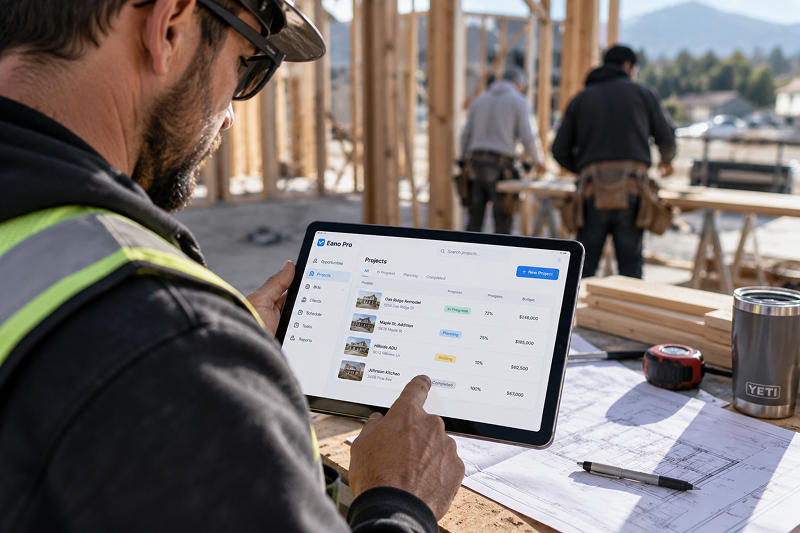
It can be tough to choose the right software for your business. A few things matter more than a long feature list:
- Automated documentation to reduce manual entry and lost paperwork.
- Accurate estimating and budget tracking to avoid overruns.
- AI takeoffs for estimating materials, if that's classically where your process starts.
- Integration with the estimating, scheduling, and accounting tools you already use.
- Reliable support and onboarding help, not just a login and a manual.
AI-powered solutions like Eano Pro focus on making these features practical — not just fancy add-ons. The result is a system your crew will actually use, which matters more than any individual feature on its own. Software nobody opens doesn't save anyone time, no matter how capable it is on paper.
It's worth testing this claim directly rather than trusting a features page. A useful question during any demo: pick a real scenario from last month — a bid that needed a fast turnaround, or a change order that had to get approved same-day — and ask the vendor to show, step by step, how their platform would have handled it. A tool that struggles to answer concretely probably struggles the same way in your actual workflow.
Key Trends in AI Construction Software for 2026
Contractors adopting AI construction software in 2026 are seeing a consistent pattern:
- Fewer change orders and surprises, thanks to smarter project tracking that catches a scope gap before the contract is signed.
- Improved safety, with predictive analytics flagging potential risks before they become issues on-site.
- More accurate cash flow forecasting, leading to better business decisions about hiring, bidding, and equipment.
Firms that embrace these tools are finding they can take on more jobs without adding back-office staff. That's a real competitive edge, and it compounds — a firm that can bid and manage twenty jobs a year with the same office headcount that used to handle twelve has a structural advantage that's hard for a slower-moving competitor to close.
The predictive-analytics trend deserves a specific caveat: it's genuinely useful, but it's pattern-matching against historical data, not a guarantee. A system flagging a likely delay based on similar past jobs is giving a project manager a heads-up worth acting on, not a certainty worth ignoring the actual site conditions for. The value is in the extra lead time it buys, not in treating the prediction as gospel.
Overcoming Common Adoption Barriers
It's normal for teams to worry about switching to new software. The biggest hurdles are usually:
- Making sure your data is secure in the cloud.
- Finding a solution that fits your budget.
- Getting a team that's used to doing things one way to actually adopt a new one.
To get buy-in, focus on the direct benefits for your team. Show how the right system makes their jobs simpler and eliminates headaches, rather than adding extra chores. A crew member who sees a tool save them twenty minutes on their first day with it is a much easier sell than one who's handed a login and a training PDF with no context for why it matters.
Budget concerns are usually easier to resolve than they first appear, once the comparison is framed correctly. The relevant number isn't the subscription cost in isolation — it's the subscription cost against the hours currently spent on manual estimating, chasing paperwork, and fixing errors that a connected system would have caught. Most teams find that comparison tips in favor of switching faster than they expected going in.
Best Practices for a Smooth Implementation
If you're ready to bring in new technology, start small. Roll out your chosen platform on one project or with one department first. Get feedback, make tweaks, and let word-of-mouth spread. Eano Pro, for example, offers onboarding support and training so your crew isn't left guessing.
Keep communication open. Make sure field and office teams know where to find resources and who to ask for help. Celebrate small wins — like shaving hours off estimate prep or reducing errors in daily logs. That's how adoption sticks.
The rollout order matters more than most teams expect. Starting with the estimating side tends to build trust fastest, because the win is visible immediately — a bid that used to take an afternoon now takes twenty minutes. Starting with something less visible, like backend reporting, often stalls because the team doing the daily work doesn't see the benefit directly.
How Eano Pro Supports AI Adoption for Construction Teams
Unlike general business software, Eano Pro was designed by and for construction professionals. It bridges the gap between jobsite realities and back-office needs. With features like automated estimates, real-time job tracking, and easy document management, it helps busy teams cut waste — not corners.
The onboarding process is built around the same principle as the rollout advice above: start with one workflow, not the whole platform at once. Eano Pro's support team works with new customers to identify which piece — estimating, scheduling, proposals, or job tracking — will show the fastest, most visible win for their specific team, and builds the rollout around that rather than a one-size-fits-all training script.
Because estimating, scheduling, and job costing live in the same platform, a team adopting Eano Pro isn't stitching together three separate tools and hoping the data stays in sync between them. That matters specifically for adoption: a tool that requires double entry between systems tends to get abandoned by a busy team within a few weeks, no matter how good any one piece of it is on its own.
Mobile access plays a bigger role in adoption than it might seem to on a features checklist. A tool that only works well from a desktop in the office is a tool the field never really adopts — it stays an office system that the crew works around rather than with. Eano Pro is built so that a field update, a photo, or a change-order note entered from a phone on-site lands in the same record the office is looking at, which is often the difference between a platform the whole team actually uses and one that only the office half does.
Switching to a platform like Eano Pro doesn't mean changing how you build. It means removing the roadblocks that slow you down, so you can focus on the work that matters.
Where Construction Management Software Fits Into a Bigger Picture
AI adoption in construction doesn't happen in isolation from the rest of how a business runs. A platform that connects estimating to customer and lead tracking means the same numbers that go into a bid stay connected to the relationship that produced it, instead of the sales side and the estimating side working from two different pictures of the same client. See the full breakdown of what a connected platform actually changes on Eano Pro's 10 benefits of construction management software.
Looking further ahead than this year's trends, the direction is fairly consistent across the industry: less standalone software, more connected platforms; less manual data entry, more of it captured automatically from the field; and less reliance on any one person's memory of how a job was priced or scheduled. None of that replaces good judgment on a jobsite — it just makes sure that judgment is working from accurate, current information instead of whatever happened to survive the trip from the field to the office.
Ready to see how it fits your crew? Book a demo and get your questions answered.