
The Real Cost of Errors in Construction Estimating (And How Software Changes the Math)
It starts with a number that looked right when you built the estimate. Six weeks into the job, you're standing on site looking at a scope item that isn't in your contract, and the conversation with the owner is one you've had before, and it never goes well.
Estimating errors happen in every contracting operation. They're not evidence of incompetence, but they're a predictable output of a complex process done under time pressure, often by people who are also running active jobs. But the frequency and severity of those errors aren't fixed. They're a function of the process you're running, the tools you're using, and the discipline you're applying to the steps between takeoff and submission.
Here's what estimating errors actually cost and where AI takeoff software moves the needle on the ones it can affect.
What Estimating Errors Actually Cost
The visible cost is rework and margin erosion.
When a missed scope item means materials or labor weren't priced in the original contract, somebody absorbs that cost. On a fixed-price contract, it's almost always the contractor. On a $600,000 job, a 3 percent estimating error is $18,000 coming out of margin — on a project where your margin might have been $54,000 to begin with. That's a third of your profit on one error.
The calculation gets worse when the error is discovered mid-project rather than at the start. Early discovery limits the exposure. Errors discovered after mobilization carry significantly higher resolution costs. Poorly defined scope and estimating gaps consistently rank as leading drivers of construction disputes globally, often leading to multi-million dollar losses.
The invisible cost is harder to quantify but just as real.
Relationship damage is the first invisible cost. When a contractor brings a change order for work that any experienced owner knows should have been in the original scope, the owner's confidence in the contractor's competence takes a hit. The change order might be legitimate. The conversation is still costly.
Bid credibility is the second. Contractors who consistently submit a number and deliver a different number develop a reputation that affects future bid invitations. That reputation compounds quietly over the years until a GC stops inviting you to bid, or an owner decides to take their next project to someone else.
Bonding capacity is the third. Estimating errors that compound into project losses affect your financial statements, which affect your surety's view of your risk profile, which affects how much work you can bond and at what rate. The downstream effects of a pattern of estimating errors reach further than any single project.
The Arcadis Global Construction Disputes Report consistently identifies poorly defined scope and estimating gaps as leading drivers of construction disputes. The money lost in dispute resolution rarely shows up in estimating error statistics — but it originates in the estimate.
The Most Common Types of Estimating Errors
Quantity errors.
These are the most frequent categories. Something was miscounted, mis-measured, or missed entirely during takeoff. Quantity errors on manual takeoff often trace to fatigue — the difference in attention quality between the first hour of a takeoff and the eighth. They also trace to plan set complexity: missed scope that lives in a detail that got skipped, or a plan conflict between sheets where you counted the wrong version.
Unit errors.
Less common than quantity errors but often more expensive. Pricing linear feet where the spec calls for square feet. Counting single units where the contract covers pairs. Unit errors are internally consistent — the math adds up correctly for the wrong unit, which is why they're hard to catch in a self-review. They tend to surface when materials are ordered, and the quantity doesn't match the plan.
Scope gap errors.
The hardest to catch and often the most expensive. These are items that aren't explicitly drawn or specified but are clearly the contractor's responsibility once the job is underway. Coordination scope between trades. Phasing requirements that add setup and teardown labor. Temporary utilities that were assumed to be owner-furnished until they weren't. The scope gap error doesn't show up in any quantity count — it shows up in a job meeting when someone asks who's responsible for something that nobody priced.
Pricing errors.
Using outdated material prices in a volatile market. The construction industry’s struggle with productivity is often tied to these types of informational silos and a lack of real-time data integration.
How Software Changes the Error Profile
AI takeoff software directly addresses quantity errors.
The software counts from the drawings with consistent focus, whether the takeoff is the first task of the morning or the last one at the end of a long day. It doesn’t skip a row because the phone rang, and it doesn’t lose its place in a window schedule because a PDF loaded slowly. On the element types it’s trained to detect well, AI takeoff is often more consistent than a human estimator working at hour eight of a long session.
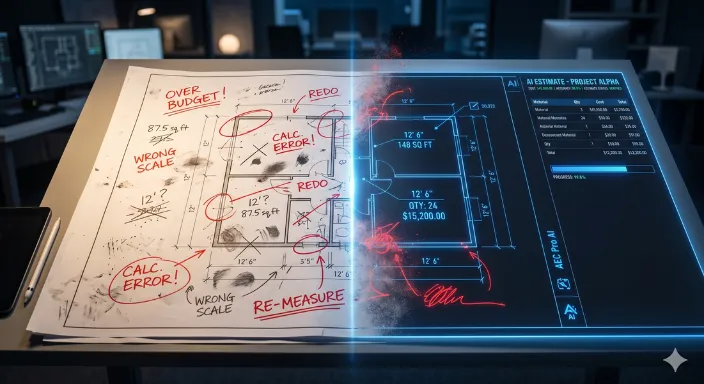
That doesn’t mean errors disappear — it means the type of errors changes. AI takeoff mistakes tend to cluster in the detection layer: elements the software misclassifies or quantities that look fine in the summary but hide an underlying detection issue. Fortunately, human review catches most of these long before they reach the estimate. The errors humans make due to fatigue or distraction, however, largely don’t appear in AI-generated counts.
What software can’t address are scope-gap errors — and that’s why the strongest results come from a hybrid workflow. You can explore Eano’s AI estimating tools to see how the software handles the heavy lifting of counting, freeing your senior estimators to focus on the high-level scope interpretation that AI isn’t ready to master.
Software doesn't address scope gap errors.
This is the most important distinction to understand. Scope gap errors require knowing what should be in the scope — and that knowledge comes from reading specifications, understanding trade coordination, and having built similar projects before. No takeoff software can fill gaps that require project knowledge to identify.
Contractors who move to AI takeoff and assume their estimating error rate has been solved across the board will still get hit by scope gap problems. The takeoff layer is faster and more consistent. The scope interpretation layer still requires a person who knows what they're doing.
Unit errors are a mixed picture.
Software is less likely to make the raw unit mistake in the detection layer — it counts walls in linear feet because that's how it measures walls. But if your estimating database is configured with the wrong unit for a line item, the software will feed it accurate quantities in the wrong format. The upstream accuracy doesn't protect you from downstream configuration errors.
Pricing errors are minimally affected by takeoff software.
Takeoff software doesn't set prices — it produces quantities. Pricing errors trace to the estimating database and the pricing review process. Some integrated platforms include pricing database management that can help keep material costs current, but the underlying discipline of verifying prices against current supplier quotes belongs in your process, regardless of what software you're using.
Projects with well-defined scope at the estimate stage experience significantly lower cost overruns than those with poorly defined scope. Software improves quantity extraction. Scope definition still requires disciplined human process.
Building an Error-Reduction Workflow
The contractors with the lowest estimating error rates aren't using the best software. They're using good software inside a disciplined process. The software handles what it can handle. The process handles the rest.
A scope lock step before takeoff begins.
Before the first plan page gets uploaded, there should be a documented decision about what's in the scope and what's excluded. This doesn't need to be a formal document — a written note on the project file is enough. But it needs to exist before counting starts. Scope drift during takeoff is how items get double-counted in one place and missed in another.
A pre-submission checklist built around your actual failure modes.
Generic checklists catch generic errors. A checklist built from your own project history catches your errors. Pull your last 10 projects where you had meaningful variance between estimated and actual cost. Look for the pattern — which line items, which project types, which scope areas. Build your checklist around that pattern.
A second-reviewer rule for bids above a dollar threshold.
Determine a project value above which every bid gets a second set of eyes before it goes out. The threshold is different for every company — the right number for a $5M GC is different from the right number for a $50M GC. What matters is having the rule, not exactly where you set it.
A date-check step for material pricing.
Material prices move. A price from six weeks ago on lumber, steel, or copper can be meaningfully different from today's market. Build a material pricing date-check into your pre-submission review. Any price older than two weeks on a volatile material gets a fresh quote before the bid goes out.
Ready to see the difference? Get a free demo today and experience how AI can transform your pre-construction workflow.